EUR
 GBP
 CAD
 AUD

 🎃Halloween🎃
 Birthday
 Occasions
 Same Day
 Flowers
 Roses
 Plants
 Gifts
 International Flower Delivery
Meaning & Symbolism of beautiful lavender flower
- 💜 Lavender meaning spans purity, devotion, calmness, and spiritual awareness — making lavender one of the most symbolically layered flowers and colors across cultures.
- 🌿 The word comes from Latin lavare ("to wash"), and Romans used lavender so heavily that a pound of its oil cost a laborer's monthly wage.
- 🌸 Lavender roses specifically express enchantment and love at first sight, while a lavender aura suggests intuition and creative sensitivity.
Lavender carries over 2,500 years of symbolic weight — from ancient Roman bathhouses to modern wedding bouquets. Understanding lavender meaning helps you pick the right flower for a birthday, choose a meaningful gift color, or simply appreciate why this purple-blue plant keeps showing up in spiritual practices worldwide. The word "lavender" itself traces back to the Latin lavare, meaning "to wash." Romans paid 100 denarii per pound for lavender oil — roughly a month's wages for a farm laborer. That price tag alone tells you how deeply people valued this plant.
Lavender symbolism through the centuries
Lavender symbolism didn't appear overnight. Ancient Egyptians used lavender in their mummification process as early as 600 BCE. They considered the plant sacred enough to preserve bodies for the afterlife.
Greeks and Romans took a different angle. They dropped lavender into communal baths, burned lavender incense during religious ceremonies, and scattered the flowers across bedroom floors. For Romans, lavender signaled cleanliness and luxury. Pliny the Elder documented lavender's price at 100 denarii per pound in his Naturalis Historia around 77 CE.
During the Middle Ages, European monks grew lavender in monastery gardens across France and England. These monks used the herb to treat everything from headaches to insect bites. Lavender also became a symbol of love and devotion — young women tucked sprigs under their pillows, hoping to dream of future husbands.
- By the 16th century, Queen Elizabeth I of England demanded fresh lavender flowers on her table daily. The Tudor court associated lavender with refinement and grace. That royal connection stuck.
- Here's a quick breakdown of how lavender symbolism shifted over time:
- Ancient Egypt (600 BCE): Sacred preservation and spiritual transition
- Ancient Rome (77 CE): Cleanliness, luxury, and sensory pleasure
- Medieval Europe (500–1400 CE): Healing, devotion, and romantic hope
- Tudor England (1500s): Royalty, grace, and sophistication
- Victorian Era (1837–1901): Mistrust and caution in the language of flowers
- 20th century onward: LGBTQ+ resistance, spiritual awakening, and calm
That Victorian twist surprises most people. While earlier centuries celebrated lavender's positive traits, Victorians assigned lavender a more guarded meaning in their floriography — the coded language of flowers. A gift of lavender could signal distrust. Context mattered then. Context matters now.

Lavender spiritual meaning: beyond the physical plant
Lavender spiritual meaning connects to purification, inner peace, and heightened awareness. Practitioners of aromatherapy, meditation, and energy healing reach for lavender more than almost any other plant.
Why? The science offers clues. A 2012 study published in the Journal of the Medical Association of Thailand found that inhaling lavender oil reduced blood pressure and heart rate in 20 healthy volunteers within just 5 minutes. Your nervous system actually responds to this scent.
Lavender in meditation and energy work
Buddhist and Hindu traditions associate lavender with the crown chakra — the energy center at the top of your head. Practitioners burn dried lavender bundles during meditation to clear mental clutter. Many yoga studios across the U.S., from Los Angeles to New York City, diffuse lavender essential oil during savasana (the final resting pose).
Lavender in Christian and European folk traditions
Some Christian legends claim lavender received its scent when Mary laid baby Jesus's clothes on a lavender bush to dry. Whether you take that literally or not, the story reinforced lavender's association with purity and protection for centuries across Southern Europe.
French and Spanish folk healers burned lavender to ward off evil spirits. They hung dried bundles above doorways — a practice you can still spot in parts of Provence today.
Practical spiritual uses
- You don't need a specific belief system to use lavender for calm. Try these approaches:
- Place a sachet of dried lavender under your pillow before sleep
- Add 4–5 drops of lavender essential oil to a warm bath
- Burn a lavender smudge stick to reset the energy in a room
- Grow a pot of Lavandula angustifolia on your windowsill as a daily reminder to breathe
- Each approach taps into the same core idea: lavender slows you down.
Lavender color meaning in art, design, and culture
Lavender color meaning blends the stability of blue with the energy of red — then softens both. The hex code for lavender sits at #E6E6FA, a pale purple-blue that designers describe as "cool, light, and slightly ethereal."
Color psychologists link lavender to creativity, imagination, and emotional balance. Interior designers in the U.S. frequently recommend lavender for bedrooms and meditation spaces. Benjamin Moore's "Lavender Ice" (2069-60) ranked among their top-selling purples in 2023.
Lavender vs. purple vs. lilac
- People confuse these three constantly. Here's the difference:
- Lavender (#E6E6FA): Pale, blue-leaning purple with a gray undertone
- Purple (#800080): Deep, saturated mix of red and blue
- Lilac (#C8A2C8): Warmer, pinker shade of light purple
- Lavender reads as gentler and more muted than either lilac or purple. Wedding planners choose lavender when couples want elegance without intensity.
Lavender and LGBTQ+ history
The lavender color carries a specific political and cultural meaning. In the 1950s and 1960s, opponents of LGBTQ+ rights used "lavender" as a derogatory label. Senator Joseph McCarthy's "Lavender Scare" of the early 1950s targeted gay and lesbian federal employees.
The LGBTQ+ community reclaimed lavender as a symbol of resistance. The lavender rhinoceros became a mascot for Boston's gay rights movement in 1973. Today, lavender represents pride, resilience, and visibility at Pride events across the country every June.
Lavender aura meaning: what energy readers see
Lavender aura meaning focuses on intuition, sensitivity, and imagination. Aura readers describe the lavender aura as one of the rarest — appearing in only about 5–7% of readings, according to practitioners at aura photography studios like Radiant Human in Brooklyn, New York.
A person with a lavender aura tends to daydream. Not in a negative way. Lavender aura carriers often work as artists, musicians, writers, or healers. They process emotions deeply and notice subtleties other people miss.
Strengths of a lavender aura
- Strong creative vision and artistic talent
- Natural empathy and emotional intelligence
- Deep connection to spiritual practices
- Ability to see beauty in ordinary moments
Challenges for lavender aura types
- Difficulty staying grounded in practical tasks
- Sensitivity to loud, chaotic environments
- Tendency to withdraw from conflict rather than address it directly
- Risk of emotional burnout from absorbing others' feelings
- If you've received a lavender aura reading, the practical takeaway is simple. Build structure around your creativity. Set boundaries around your empathy. Your sensitivity works best when you protect it.
Lavender love meaning: romance and devotion
Lavender love meaning walks a fascinating line between enchantment and caution. Giving someone lavender flowers can express deep, even overwhelming attraction — the kind of love that hits you unexpectedly.
In the Victorian language of flowers, lavender communicated "I don't quite trust you" or "I'm cautiously devoted." Modern flower-givers rarely intend that message. Today, lavender in romantic contexts signals grace, femininity, and admiration.
When to give lavender flowers for love
- Early dating: Lavender communicates interest without the intensity of red roses
- Anniversaries: Lavender adds a layer of thoughtful elegance to celebration bouquets
- Apologies: The calming nature of lavender softens a sincere apology
- Mother's Day (second Sunday of May): Lavender honors maternal devotion beautifully
- Valentine's Day (February 14): A lavender bouquet stands out from the sea of red
Florists across the U.S. report that lavender-themed arrangements spike in popularity during spring — especially between March and May. The plant blooms naturally from June through August in most American growing zones (USDA zones 5–9).
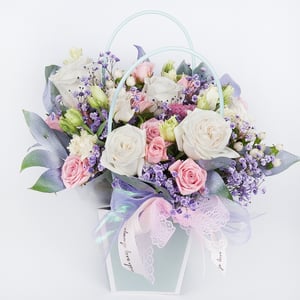
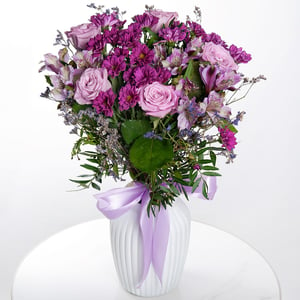
Looking for lavender tones?
Browse arrangements from local florists and pick one that suits the occasion.
Meaning of lavender roses: enchantment at first sight
The meaning of lavender roses deserves its own spotlight. Lavender roses carry a message distinct from other rose colors — and most people don't know the difference.
A red rose says "I love you." A yellow rose says "You're my friend." A lavender rose? A lavender rose says "I'm enchanted by you." The emotion falls somewhere between fascination and love at first sight.
Color variations in lavender roses
- Rose growers produce several shades within the lavender range:
- Pale lavender roses: Convey grace and gentleness — suitable for sympathy arrangements
- Medium lavender roses (classic): Express enchantment and romantic wonder
- Deep lavender roses (mauve): Suggest mystery and uniqueness
- Blue-toned lavender roses: Signal the extraordinary or the unattainable
- Sterling Silver roses, first bred in 1957 by Gladys Fisher in the U.S., remain one of the most popular true lavender rose cultivars. Blue Moon roses, introduced in Germany in 1964 by Mathias Tantau, offer a cooler lavender tone.
Best occasions for lavender roses
Send lavender roses when you want your flowers to say something different from the usual. A bouquet of 12 lavender roses tells someone "You fascinate me" without the commitment weight of red. Lavender roses also work well for graduations, new job celebrations, and creative achievements — moments when you want to honor someone's unique path.
Lavender name meaning: the word behind the flower
Lavender name meaning traces a clear etymological path. The word "lavender" entered English from the Anglo-Norman lavandre, which came from Medieval Latin lavandula. Most linguists connect lavandula to Latin lavare — "to wash."
Some scholars propose an alternative origin. They point to Latin livere ("to be bluish"), linking the name directly to the plant's color rather than its cleaning uses. The debate continues in academic circles, but the "washing" etymology dominates most dictionaries, including Merriam-Webster and the Oxford English Dictionary.
Lavender as a given name
The name Lavender gained popularity as a first name in the U.S. starting around 2015. The Social Security Administration recorded 47 baby girls named Lavender in 2020 and 89 in 2022 — nearly doubling in just two years. Pop culture drove part of this trend. Lavender Brown appeared as a character in J.K. Rowling's Harry Potter series, first published in 1997.
Parents choosing the name Lavender typically associate it with grace, calm, and natural beauty. The name works well across age groups — no one would blink at a Lavender in a kindergarten or a boardroom.

Types of lavender and what each variety means
Not all lavender carries the same meaning. With over 450 known varieties in the genus Lavandula, the specific type you grow, give, or display can shift the symbolism slightly.
English lavender (Lavandula angustifolia)
English lavender grows best in USDA zones 5–8. This variety produces the most fragrant flowers and the sweetest essential oil. English lavender symbolizes calm, purity, and traditional devotion. Most bridal bouquets featuring lavender use this variety.
French lavender (Lavandula dentata)
French lavender thrives in warmer climates — USDA zones 8–11. The toothed leaves distinguish French lavender from English varieties. French lavender represents creativity and artistic flair. Southern California and Gulf Coast gardeners favor this type.
Spanish lavender (Lavandula stoechas)
Spanish lavender stands out with distinctive "rabbit ear" petals at the top of each flower head. The plant tolerates poor soil and drought — growing well in zones 7–10. Spanish lavender carries associations with resilience and independence.
Lavandin (Lavandula × intermedia)
Lavandin — a natural hybrid of English and Portuguese lavender — produces more oil per plant than any pure species. French farmers grow approximately 80% of the world's lavandin crop. Lavandin symbolizes abundance and productivity.

Practical tips: growing and caring for lavender in the U.S.
- Lavender grows well across most of the continental United States. Follow these steps to keep your lavender healthy:
- Plant lavender in full sun — the plant needs at least 6 hours of direct sunlight daily
- Use well-draining soil with a pH between 6.5 and 7.5
- Space plants 12–18 inches apart for English varieties and 24–36 inches for larger types
- Water deeply once every 1–2 weeks after the plant establishes roots (roughly 4–6 weeks after planting)
- Prune lavender by one-third in early spring, before new growth starts
- Harvest flower stalks when about half the buds on each stalk open
Common mistakes to avoid
Overwatering kills more lavender plants than any pest or disease. Lavender roots rot in soggy soil. Skip the mulch around the plant's base — mulch traps moisture that lavender hates.
Don't plant lavender in heavy clay soil without amending it first. Mix in coarse sand or perlite to improve drainage. And avoid fertilizing too heavily — rich soil produces leggy, weak plants with fewer flowers.
Humidity causes trouble in the southeastern U.S. Gardeners in states like Florida, Georgia, and Alabama should choose French or Spanish varieties over English lavender. English lavender struggles when nighttime humidity stays above 60% consistently.
When lavender fits the occasion — and when it doesn't
- Lavender works beautifully for many occasions. But the flower carries enough symbolic complexity that you should think twice in certain situations.
- Great choices for lavender:
- Weddings and bridal showers (symbolizing devotion and elegance)
- Mother's Day gifts (honoring grace and calm strength)
- Housewarming presents (lavender plants purify air and bring tranquility)
- Get-well arrangements (the scent promotes relaxation and recovery)
- Easter and spring celebrations (seasonal timing aligns perfectly)
- Use caution with lavender for:
- Traditional sympathy arrangements in some Southern U.S. communities — white flowers remain the expected choice
- First-date gifts — some recipients may read "uncertainty" into lavender's Victorian meaning
- Formal corporate gifts — lavender reads as personal rather than professional
- For sympathy contexts, mixing lavender with white lilies or white roses balances the emotional tone effectively. The lavender adds warmth; the white anchors the arrangement in tradition.
Your turn: let lavender mean something to you
Lavender carries 2,500 years of accumulated meaning — purity, devotion, spiritual awareness, creative energy, even political resistance. No single definition captures the whole story. And honestly, that's what makes lavender so compelling as both a flower and a color. Pick the meaning that resonates with your life right now. Grow a plant on your patio this spring. Send lavender roses to someone who fascinates you. Tuck a sachet in your desk drawer and breathe it in during a stressful Tuesday afternoon. What does lavender mean to you?
Send flowers today
Choose your bouquet, add a message, and let a local florist hand-deliver it.
FAQ
What does lavender symbolize in a relationship?▾
Lavender expresses enchantment, devotion, and growing love — a gentler emotion than the passionate declaration of red roses. Lavender roses specifically signal "you fascinate me" rather than "I'm deeply committed."
Does lavender have a negative meaning?▾
In Victorian floriography, lavender could signal distrust or cautious affection. Modern usage almost always leans positive — calm, grace, and spiritual connection. Context and cultural setting determine the tone.
What is the spiritual meaning of smelling lavender unexpectedly?▾
Many spiritual practitioners interpret an unexpected lavender scent as a sign of angelic presence or spiritual protection. A 2019 survey by the American Herbalists Guild found that 62% of respondents associated lavender's aroma with "feeling spiritually supported."
Can I give lavender flowers for a funeral?▾
Lavender works in sympathy arrangements when paired with white flowers. On its own, lavender may read as too cheerful for some traditional funerals. Mixing lavender with white lilies or chrysanthemums strikes the right balance.
What USDA growing zones work best for lavender?▾
English lavender thrives in zones 5–8. French and Spanish varieties prefer zones 7–11. Lavandin grows well in zones 5–9. Most American gardeners can grow at least one lavender variety successfully.
Is Lavender a good baby name?▾
The name Lavender nearly doubled in U.S. registrations between 2020 and 2022, jumping from 47 to 89 newborns. Parents associate the name with elegance, calm, and natural beauty — a name that ages well from childhood through adulthood.