EUR
 GBP
 CAD
 AUD

 🎃Halloween🎃
 Birthday
 Occasions
 Same Day
 Flowers
 Roses
 Plants
 Gifts
 International Flower Delivery
Four Leaf Clover Meaning & Symbolism
- 🍀 Each clover leaf carries a distinct meaning: three leaves stand for faith, hope, and love, while a fourth adds luck — and rarer five- or six-leaf clovers layer in money and fame.
- 🔮 Clover spiritual meaning centers on protection, renewal, and connection to nature, and the plant's symbolism shifts by color — white signals purity, red signals passion, and purple signals royalty.
- 💍 Clover jewelry (especially the four-leaf necklace) doubles as a wearable talisman, with roots in both Celtic tradition and modern fashion houses like Van Cleef & Arpels, whose Alhambra line launched in 1968.
Clover meaning goes far beyond a lucky charm you hunt for in the backyard. The genus Trifolium contains roughly 300 species worldwide, and humans have attached spiritual, religious, and romantic symbolism to this small plant for at least 2,000 years. Whether you spotted a rare four-leaf clover, received clover jewelry as a gift, or simply want to understand the deeper symbolism, this guide breaks down every variation — from the classic three-leaf to the almost mythical six-leaf — so you can speak the language of clovers with confidence.
What does clover mean? A quick botanical primer
Clover belongs to the genus Trifolium, a Latin name that literally translates to "three leaves." Botanists recognize about 300 species in this genus, and the plants thrive on every continent except Antarctica. Most Americans encounter white clover (Trifolium repens) in lawns and parks — the same species that produces the occasional four-leaf mutation.
The word "clover" traces back to the Old English clāfre, first recorded around the year 725 CE. For centuries, European farmers grew clover as livestock forage and a natural soil fertilizer. Clover fixes nitrogen through symbiotic bacteria in its root nodules, enriching the soil at roughly 80–200 pounds of nitrogen per acre each year.
So the clover meaning starts practical. It feeds animals, restores soil, and attracts pollinators. The symbolism grew from there.
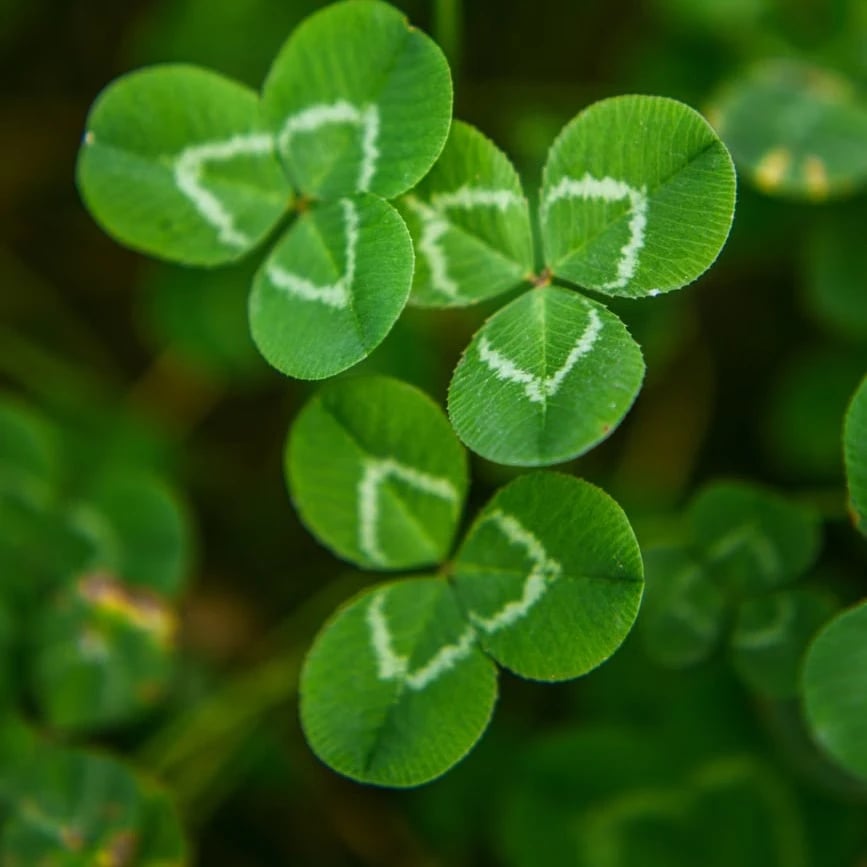
Three-leaf clover meaning
The three-leaf clover meaning connects directly to one of the most famous legends in Christianity. Around 432 CE, Saint Patrick reportedly used the three-leaf shamrock to explain the Holy Trinity — Father, Son, and Holy Spirit — to the pagan Irish.
Each leaf carries its own significance:
- First leaf represents faith
- Second leaf represents hope
- Third leaf represents love
Ireland adopted the shamrock as a national emblem, and Irish immigrants brought the symbol to the United States during the 1840s famine migration. Today, over 30 million Americans claim Irish ancestry, according to U.S. Census data.
Here's the thing: "shamrock" and "three-leaf clover" overlap, but they aren't always the same species. The word shamrock comes from the Irish seamróg, meaning "young clover." Botanists still debate which exact species Saint Patrick held up. Most likely, the Saint picked whatever three-leaf plant grew nearby.
Beyond religion: everyday three-leaf symbolism
Outside Christian tradition, the three-leaf clover meaning expands. Celtic druids associated the triple leaf with earth, sea, and sky. Modern interpretations sometimes swap in "be mine," borrowing from the Victorian language of flowers.
A three-leaf clover tattoo? Common. A three-leaf pendant? Classic. The meaning stays rooted in balance and wholeness.




Four-leaf clover meaning and symbolism
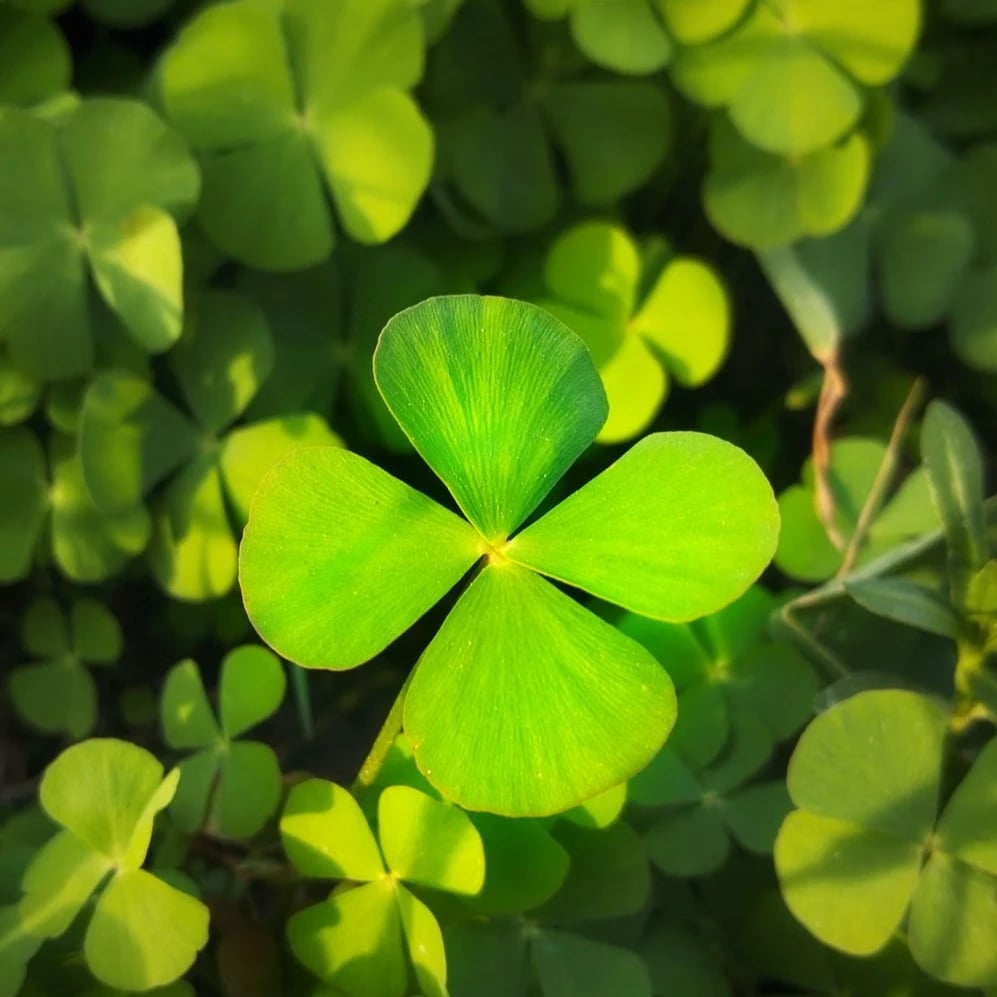
Now for the star of the show. The four-leaf clover meaning adds "luck" to the trio of faith, hope, and love. That fourth leaf appears roughly once in every 5,000 to 10,000 clovers — a mutation caused by a recessive gene and environmental factors, according to a 2010 study from the University of Georgia.
Four-leaf clover symbolism stretches across centuries and cultures:
- Medieval Europe: Carrying a four-leaf clover let you see fairies and detect witches, according to English folklore documented as early as 1620
- Celtic belief: Druids treated the four-leaf clover as a protective ward against evil spirits
- American tradition: Abraham Lincoln reportedly carried a four-leaf clover, though historians debate the anecdote
- Modern pop culture: The four-leaf clover appears on logos, greeting cards, and St. Patrick's Day merchandise worth over $6 billion in annual U.S. spending
What each leaf symbolizes
The traditional breakdown goes:
- First leaf — faith
- Second leaf — hope
- Third leaf — love
- Fourth leaf — luck
Some sources swap "faith" for "respect" or "love" for "happiness." The variations depend on regional folklore. The core idea stays the same: the fourth leaf grants something extra.
How rare is a four-leaf clover, really?
Scientists at the University of Georgia and Crop Science Society of America studied white clover genetics extensively. A four-leaf clover shows up in about 1 of every 5,000 three-leaf plants. The mutation involves at least 3 genes, plus environmental triggers like soil chemistry and sunlight exposure.
Fun fact: the world record for most leaves on a single clover stem stands at 56 leaves. Shigeo Obara of Japan grew that specimen, and Guinness World Records verified the record in 2009.
Five-leaf clover meaning
A five-leaf clover meaning centers on money and financial good fortune. These mutations pop up far less frequently than four-leaf specimens — roughly 1 in 20,000 to 1 in 100,000 plants, depending on the source.
In Japanese culture, the five-leaf clover holds special status. Each leaf maps to a value:
- First leaf — faith
- Second leaf — hope
- Third leaf — love
- Fourth leaf — luck
- Fifth leaf — money (or sometimes "fame")
Some folklore traditions warn that a five-leaf clover brings bad luck if you keep it only for yourself. The custom in parts of rural Ireland? Give the five-leaf clover away.
Not everyone agrees on the interpretation. That's normal with folk symbolism. The financial association dominates in modern American usage, though.
Six-leaf clover meaning
Six-leaf clover meaning pushes into truly rare territory. Estimates suggest a six-leaf clover occurs in roughly 1 in 200,000 plants. The sixth leaf traditionally stands for fame, notoriety, or divine blessing.
Some spiritual practitioners link the six-leaf clover to heightened intuition. Others connect the six leaves to the six directions: north, south, east, west, up, and down.
Honestly, documented folklore about six-leaf clovers is thin. Most sources extrapolate from the established four- and five-leaf meanings. The rarity itself becomes the message — finding one signals exceptional fortune.
Quick comparison:
| Leaf count | Approximate rarity | Traditional meaning |
|---|---|---|
| 3 leaves | Standard | Faith, hope, love |
| 4 leaves | 1 in 5,000 | Faith, hope, love, luck |
| 5 leaves | 1 in 20,000+ | Faith, hope, love, luck, money |
| 6 leaves | 1 in 200,000+ | All above + fame or divine favor |
Clover flower meaning by color
Clover flower meaning shifts dramatically with color. The genus Trifolium produces white, red, pink, purple, and even yellow blooms. Here's what each color signals.
White clover
White clover (Trifolium repens) symbolizes purity, innocence, and "think of me." Victorian-era Americans tucked white clover into letters and bouquets as a gentle romantic gesture. White clover also represented good luck in rural English traditions.
Red clover
Red clover meaning focuses on passion, vitality, and hard work. Trifolium pratense — the botanical name for red clover — grows up to 32 inches tall and blooms from May through September across most of the continental U.S. Vermont designated red clover as its state flower in 1895.
Red clover also carries medicinal associations. Native American tribes, including the Cherokee and Iroquois, brewed red clover tea for respiratory issues. Modern herbalists still sell red clover supplements, though the FDA has not approved red clover for treating any specific medical condition.
Purple clover
Purple clover blossoms suggest royalty, dignity, and spiritual depth. Purple has carried regal connotations since ancient Rome, when Tyrian purple dye cost more per ounce than gold.
Pink clover
Pink clover combines the innocence of white with the warmth of red. Pink clover flowers typically signal gentle affection, gratitude, and maternal love — making pink clover a thoughtful pick for Mother's Day (the second Sunday of May in the U.S.).
Celebrating a fresh start or a new chapter?
Mark the moment with blooms that wish someone luck on the road ahead.
Clover spiritual meaning
Clover spiritual meaning draws from Celtic, Christian, and pagan traditions simultaneously. The plant sits at a crossroads of multiple belief systems.
Celtic and druidic traditions
Celtic druids revered the three-leaf clover as a sacred plant at least 2,000 years ago. The triple-leaf pattern mirrored the triskele, a spiral motif found on Neolithic stones at Newgrange in Ireland (built around 3200 BCE). Druids believed clover wards off evil spirits and grants the ability to see fairies.
Christian symbolism
Saint Patrick's three-leaf teaching made clover a symbol of the Holy Trinity. Medieval monks cultivated clover in monastery gardens both for spiritual symbolism and practical nitrogen fixation.
Modern spiritual practices
Today, spiritual practitioners use clover in several ways:
- Carry a dried four-leaf clover in a wallet for financial protection
- Place clover under a pillow for dreams of clarity and guidance
- Burn dried clover as incense during rituals focused on abundance
- Plant clover near the front door to invite positive energy into a home
Clover spiritual meaning also overlaps with renewal. The plant grows back aggressively after mowing, surviving harsh winters across USDA Hardiness Zones 3 through 10. That resilience resonates with people navigating personal challenges.
Clover leaf meaning: why the number of leaves matters
Clover leaf meaning depends almost entirely on leaf count. A standard three-leaf clover barely registers as special. Add one leaf, and you hold a symbol that launched a billion-dollar greeting card industry.
The genetic mechanism behind extra leaves involves a "fortunate" allele — yes, scientists actually call the gene for extra leaves by that nickname. Research published in Crop Science (2010) identified multiple quantitative trait loci (QTL) on chromosomes that control leaf number.
Temperature stress, soil nutrient levels, and even UV exposure influence whether a clover plant expresses extra leaves. A clover patch in partial shade with slightly acidic soil (pH 6.0–6.5) tends to produce more mutations than a patch in full sun.
So clover leaf meaning combines genetics and environment. Luck meeting science.
Clover jewelry meaning: from ancient talismans to modern fashion
Clover jewelry meaning bridges folklore and fashion. People have worn clover-shaped amulets for centuries, and the trend shows no sign of fading.
Historical roots
Medieval Europeans pressed four-leaf clovers into wax seals and wore them as pendants for protection. Irish immigrants in the 1800s brought clover brooches to America, where the jewelry doubled as a cultural marker and good-luck charm.
The Van Cleef & Arpels effect
Van Cleef & Arpels launched the Alhambra collection in 1968, featuring a four-leaf clover motif set in gold with mother-of-pearl, onyx, or malachite. A single Vintage Alhambra pendant retails for roughly $3,000–$5,500 today. The design transformed clover jewelry from folk accessory to luxury statement.
Clover necklace meaning
A clover necklace meaning typically centers on luck, protection, and love. Gift-givers choose clover necklaces for:
- Graduations — wishing luck on a new chapter
- Birthdays — especially March birthdays, near St. Patrick's Day (March 17)
- Recovery milestones — symbolizing resilience and renewal
- Anniversaries — the four leaves echoing faith, hope, love, and luck
The material matters too. Gold clover necklaces lean toward luxury and permanence. Silver versions skew casual and youthful. Enamel or gemstone-set clovers carry added color symbolism — green for growth, white for purity, red for passion.
Choosing clover jewelry: practical tips
Pick clover jewelry based on the recipient's style and the occasion. Here are some practical guidelines:
- Match the metal to existing pieces — gold for warm-toned collections, silver for cool-toned
- Consider size — a pendant under 0.5 inches suits everyday wear; 1 inch or larger works as a statement piece
- Check the symbolism of added stones — emerald reinforces luck, moonstone adds spiritual depth, diamond signals lasting commitment
- Verify craftsmanship — look for solid construction, secure clasps, and consistent enamel application
How clover symbolism fits American holidays and occasions
Clover symbolism plugs naturally into several American holidays. Here's a quick calendar guide:
St. Patrick's Day (March 17): The most obvious connection. Over 149 million Americans celebrate St. Patrick's Day, according to the National Retail Federation. Clover gifts, green bouquets, and shamrock-themed arrangements peak during the first two weeks of March.
Mother's Day (second Sunday of May): Pink or white clover flowers make a gentle addition to mixed bouquets. The clover meaning of love and hope aligns perfectly.
Graduation season (May–June): A four-leaf clover charm or necklace says "good luck on your next chapter" without being heavy-handed.
Thanksgiving (fourth Thursday of November): Clover's connection to abundance and gratitude gives the symbol a secondary home during fall celebrations.
New Year's Eve (December 31): In German-American communities, four-leaf clover motifs appear alongside chimney sweeps and pigs as traditional New Year's luck symbols.
Common mistakes when interpreting clover symbolism
People trip up on clover meaning in a few predictable ways. Watch for these:
Confusing shamrocks with four-leaf clovers. A shamrock has three leaves. Always. A four-leaf clover carries different symbolism. Mixing them up in a gift or tattoo sends the wrong message.
Assuming all clovers are Irish. Clovers grow natively across Europe, Asia, North Africa, and the Americas. Irish culture popularized the symbolism, but the plant belongs to no single nation.
Ignoring color meaning. A red clover and a white clover carry different messages. Sending red clover for sympathy feels off. White or purple works better for solemn occasions.
Believing rarity equals value. A five-leaf clover is rarer than a four-leaf. That doesn't automatically make the five-leaf clover "better" symbolically. Most people associate four leaves with the strongest positive meaning.
Overlooking the spiritual dimension. Clover spiritual meaning matters to many recipients. A clover gift to someone with Celtic roots or pagan beliefs carries weight that a casual giver might not expect.
How to preserve a real four-leaf clover
Found one? Great. Now keep it intact.
- Pick the clover with at least 2 inches of stem — this prevents the leaves from curling
- Press the clover between two sheets of wax paper inside a heavy book for 7–10 days
- Apply a thin coat of clear-drying craft glue once the clover dries, sealing both sides
- Store in a rigid frame, laminated pouch, or resin pendant to prevent crumbling
- Keep away from direct sunlight — UV rays fade the green within weeks
A properly preserved clover lasts years. Some families pass pressed four-leaf clovers through multiple generations.
Your turn
Clover meaning runs deeper than most people realize. A single leaf count changes the entire message. A color shift transforms the tone. And a clover-shaped necklace can carry 2,000 years of spiritual tradition around someone's neck.
Next time you spot clover in a park or a pendant in a jewelry store, you'll know exactly what each detail communicates. And if you're choosing a clover-themed gift for someone — whether a birthday, graduation, or St. Patrick's Day — match the leaf count and color to the message you want to send.
What does clover mean to you? Sometimes the best symbolism is the personal kind.
Someone’s good news worth celebrating?
Send your wishes with a cheerful bouquet that says congratulations.