 EUR
EUR
 GBP
GBP
 CAD
CAD
 AUD
AUD

 ✨Boss’s Day✨
 Birthday
 Occasions
 Same Day
 Flowers
 Roses
Roses
 Plants
 Gifts
Gifts
 International Flower Delivery
Flowers in Greek Mythology & Beyond
- 🌸 Greek myths gave origin stories to at least 12 common flowers — narcissus, hyacinth, anemone, crocus, and lotus among them — and each bloom still carries its ancient symbolic meaning today.
- 🪷 The lotus flower bridges Greek, Buddhist, and Egyptian mythology, symbolizing everything from forgetfulness in Homer's Odyssey to spiritual enlightenment in Buddhist scripture.
- 🌺 Flower myths extend far beyond Greece: the Hawaiian naupaka legend and Norse mythological blooms show that cultures worldwide attach deep emotional narratives to petals.
Ancient Greeks named at least 30 plants and flowers after gods, nymphs, and mortals — and those names still sit on the labels at your local nursery. Flowers in Greek mythology carry stories of heartbreak, divine rage, forbidden love, and transformation. You'll recognize most of these blooms from everyday bouquets. Understanding their mythological roots changes the way you look at a simple garden bed or a gift arrangement. This guide walks you through the most famous mythological flowers, stretches beyond Greece into Buddhist and Hawaiian traditions, and gives you practical tips for choosing blooms that carry real narrative weight.
Narcissus: the flower myth everyone knows wrong
The narcissus flower myth usually gets boiled down to "vain guy stares at reflection, turns into flower." The real story hits harder. Ovid tells it fully in Metamorphoses (Book III, lines 339–510, written around 8 AD). Narcissus didn't just admire himself. He fell so deeply in love with his own reflection that he wasted away completely, refusing food and water. The nymph Echo loved Narcissus first. She could only repeat his last words — a curse from Hera. Narcissus rejected Echo. Echo faded until only her voice remained.
When Narcissus finally died beside the pool, the gods placed a white-and-gold flower where his body lay. That flower — Narcissus poeticus — still grows wild across Mediterranean hillsides. Here's the detail most articles skip: the ancient Greeks associated narcissus with death, not vanity. Persephone picked narcissus flowers the moment Hades dragged her into the underworld. The bloom served as a funerary offering.
So the next time you see a patch of daffodils (daffodils belong to the Narcissus genus), remember: the Greeks considered that flower a doorway between life and death.

Anemone in Greek mythology: born from blood
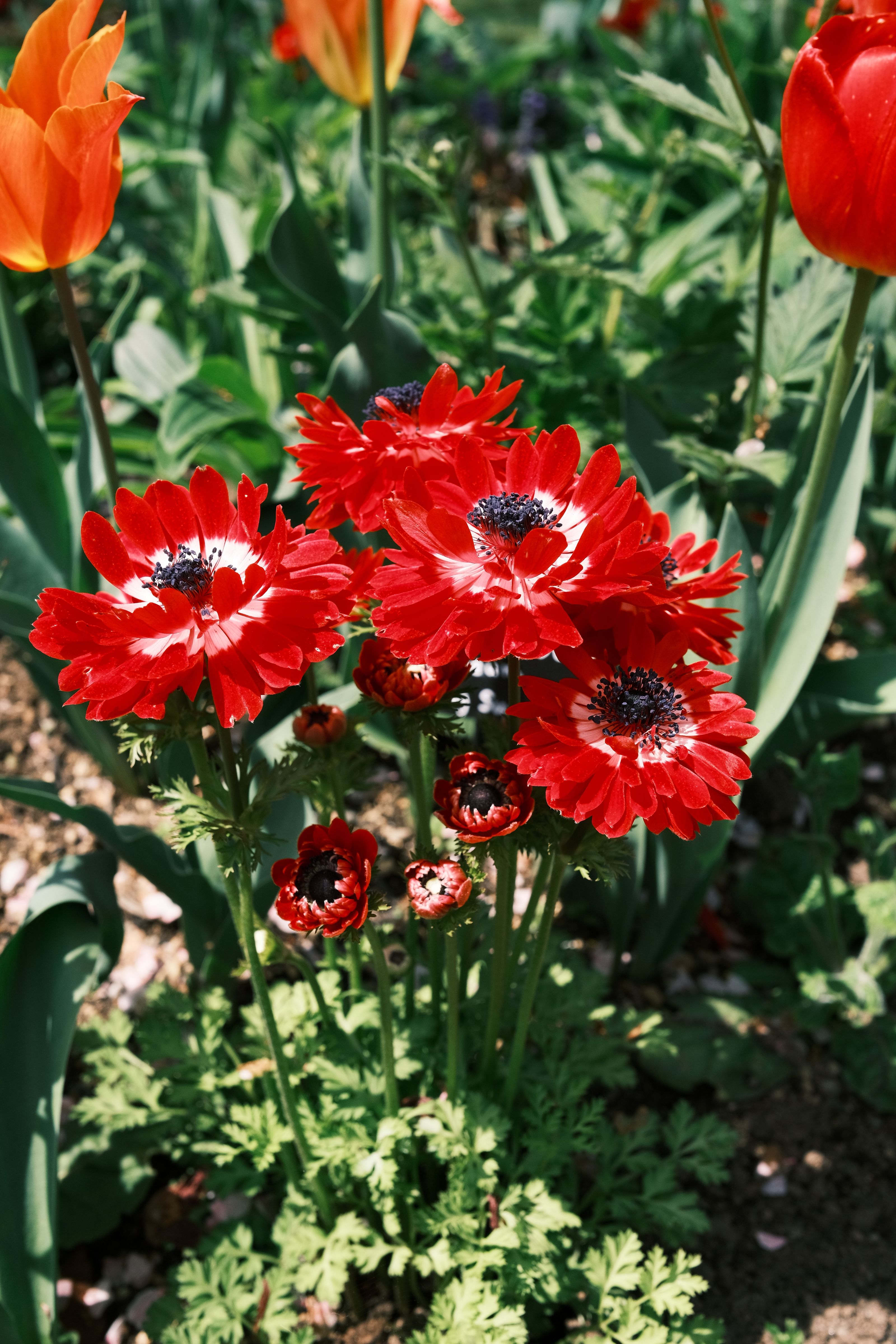
The anemone Greek mythology connection begins with Aphrodite and Adonis. Adonis — a mortal so handsome that Aphrodite herself fell for him — died from a wild boar's tusk during a hunt. Aphrodite rushed to his side. Her tears mixed with his blood on the ground. Red anemones sprang from that mix.
The Greek word anemos means "wind." Ancient Greeks called the anemone the "windflower" because the petals open only when wind blows. Bion of Smyrna wrote a funeral lament for Adonis around 100 BC, describing the red flowers rising from every drop of blood.
A lesser-known version of this myth credits Persephone. In some tellings, Persephone and Aphrodite both loved Adonis. Zeus split Adonis's year: 4 months with Persephone, 4 months with Aphrodite, and 4 months of his own choosing. Adonis gave his free months to Aphrodite. That angered Ares (or in some versions, Artemis), who sent the boar.
What makes the anemone myth different
Most flowers in mythology emerge from transformation — a person becomes a plant. The anemone grows from spilled blood instead. That distinction matters. The anemone represents grief, not metamorphosis. Florists in the U.S. still use red anemones in sympathy arrangements, often without knowing the mythological reason.
Lotus flower in Greek mythology: Homer's dangerous bloom
The lotus flower Greek mythology story appears in Book IX of the Odyssey (written around 725 BC). Odysseus and his crew land on the island of the Lotus-eaters. Three scouts eat the lotus fruit. Those scouts immediately forget their homes, families, and mission. They want nothing except to stay on the island and eat more lotus.
Odysseus drags the three men back to the ships by force. He ties them beneath the rowing benches. The lotus, in Homer's telling, causes total amnesia and blissful apathy. Scholars debate which real plant Homer meant — candidates include the jujube fruit (Ziziphus lotus), Egyptian blue water lily (Nymphaea caerulea), and opium poppy.
Lotus flower symbolism in Buddhism
The lotus flower symbolism shifts dramatically when you cross from Greek to Buddhist tradition. Buddhists revere the lotus — specifically Nelumbo nucifera — because the flower grows from muddy water yet emerges clean and beautiful. The Lotus Sutra, one of the most influential Mahayana Buddhist texts (composed between 100 BC and 200 AD), uses the lotus as its central metaphor.
- Buddhist lotus symbolism breaks down by color:
- White lotus stands for mental purity and spiritual perfection
- Pink lotus honors the historical Buddha, Siddhartha Gautama
- Blue lotus represents wisdom and control over the senses
- Red lotus signifies compassion and love of the heart
- Purple lotus marks the Noble Eightfold Path in esoteric traditions
Here's what catches most people off guard. The symbolism of the lotus flower in Buddhism is almost the opposite of its Greek meaning. Homer's lotus erases memory and purpose. The Buddhist lotus sharpens awareness and awakens consciousness. Same flower family, two civilizations, completely opposite lessons.
Lotus flower in Egyptian mythology
Egypt adds a third layer. Ancient Egyptians associated the blue water lily (often called "Egyptian lotus") with the sun god Ra. The flower opens at dawn and closes at dusk. Egyptians placed lotus blossoms on mummies and painted them on tomb walls at Karnak (dating to roughly 1550 BC). The lotus symbolized rebirth and the daily renewal of the sun.
Hyacinth: Apollo's accidental kill
Flowers in Greek mythology often mark a god's grief, and hyacinth delivers the saddest version. Apollo loved a Spartan prince named Hyakinthos. The two practiced discus throwing together. A discus thrown by Apollo (or, in some versions, redirected by the jealous West Wind, Zephyrus) struck Hyakinthos in the head. Hyakinthos died.
Apollo refused to let Hades claim the boy's spirit entirely. From the blood-soaked earth, Apollo raised a new flower and inscribed the petals with the Greek letters "AI AI" — a cry of mourning. That flower became the hyacinth.
Quick note: the ancient Greek "hyacinth" probably wasn't the bulb we buy at garden centers today. Botanists believe the original flower may have been a larkspur (Delphinium ajacis) or a type of iris. The modern Hyacinthus orientalis arrived in Western Europe from the Ottoman Empire in the 16th century.
The Spartans held an annual 3-day festival called the Hyacinthia at Amyclae, just south of Sparta, to honor both Hyakinthos and Apollo. The festival included feasts, songs, processions, and athletic contests. Pausanias described the festival in his Description of Greece (written around 150 AD).
Looking for flowers with a story?
Browse arrangements from local florists and pick one that suits the occasion.
Magical flowers in mythology beyond Greece
Crocus and saffron: love and the underworld
Crocus (or Krokos) was a mortal youth who loved a nymph named Smilax. The gods transformed both — Krokos into the saffron crocus and Smilax into a vine. Saffron crocus (Crocus sativus) produces the world's most expensive spice by weight, at roughly $5,000–$10,000 per pound in 2024.
The crocus also ties to Persephone. Homer's Hymn to Demeter (circa 650 BC) describes Persephone gathering roses, violets, irises, hyacinths, and crocuses in a meadow just before Hades abducts her. The crocus appears in that scene as a lure — the earth opens wide right where the flowers grow thickest.
The sunflower: Clytie's obsession
The water nymph Clytie loved the sun god Helios (later merged with Apollo in Roman retellings). Helios abandoned Clytie for a mortal princess named Leucothoe. Clytie, consumed by jealousy, told Leucothoe's father about the affair. The father buried Leucothoe alive.
Helios refused to forgive Clytie. She sat on bare ground for 9 days, tracking the sun's arc across the sky, eating nothing. On the ninth day, her legs rooted into the earth and her face became the heliotrope — a flower that always turns toward the sun. Ovid recounts the story in Metamorphoses (Book IV, lines 234–270).
Technically, the ancient heliotrope isn't the giant sunflower (Helianthus annuus) native to North America. The true Clytie flower is the common heliotrope (Heliotropium europaeum). But the sunflower inherited the story over centuries of retelling.
Iris: the rainbow's messenger
Iris served as personal messenger to Hera. She traveled between Mount Olympus and the human world on a rainbow bridge. The iris flower — all 310+ species of it — carries her name. Ancient Greeks planted purple irises on women's graves, believing Iris would guide the dead to the afterlife.
The rose: blood of Aphrodite
Multiple origin stories compete. One version: Aphrodite stepped on white roses while rushing to the dying Adonis. Her blood stained the roses red forever. Another version from Anacreon's poems (circa 570 BC) claims roses sprang from the sea foam alongside Aphrodite herself.
Chloris, the Greek goddess of flowers (Flora in Roman myth), also plays a role. Chloris found the lifeless body of a nymph in the forest and transformed the corpse into the first rose. She asked Aphrodite for beauty, Dionysus for intoxicating fragrance, and the Three Graces for charm, brilliance, and joy.
The naupaka flower legend: a Hawaiian parallel
Flower mythology extends far beyond the Mediterranean. The naupaka flower legend comes from Hawaiian tradition and rivals any Greek myth for emotional impact.
Two versions circulate widely. In the most popular telling, a princess named Naupaka fell in love with a commoner named Kaui. Their love violated social rules. A kahuna (priest) told them to seek the blessing of Pele, the volcano goddess, at a temple on the mountain. Pele refused. The couple separated — Naupaka gave Kaui half of a flower from her hair and kept the other half.
Today, the naupaka plant (Scaevola taccada) grows in two forms: one near the beach (naupaka kahakai) and one on the mountains (naupaka kuahiwi). Each plant produces only half-flowers. Hawaiian tradition says the two halves will reunite only when the lovers meet again. Botanically, the naupaka's zygomorphic (one-sided) flower shape creates the "half-flower" appearance.
If you travel to Hawaii, you'll spot beach naupaka growing wild along nearly every shoreline.
Why the Greeks turned people into flowers
- Most competing articles list mythological flowers without explaining the why. Here's a perspective the top-ranking pages overlook.
- Greek metamorphosis myths served 3 purposes:
- Explain natural phenomena. Why does this flower only grow in blood-red? Why does saffron crocus bloom in autumn? The myths answered questions before botany existed.
- Preserve the memory of the dead. Transforming a dead lover into a flower meant grief didn't end in nothingness. The beloved's essence persisted. Apollo could visit his hyacinth garden and remember Hyakinthos.
- Warn mortals against excess. Narcissus died from self-obsession. Clytie withered from jealous fixation. The flowers left behind acted as cautionary monuments.
The philosopher Empedocles (circa 490–430 BC) believed souls could transmigrate into plants. That belief system — shared by Pythagoras — fed the Greek appetite for transformation stories. Flowers weren't random endpoints. The Greeks saw plant life as genuinely alive, ensouled, and worthy of reverence.








How to choose flowers with mythological meaning
You now have a catalog of stories. Put that knowledge to work.
Matching mythological flowers to occasions
- Red anemones work well for sympathy bouquets — the Adonis myth gives them a built-in grief narrative
- Narcissus (daffodils) suit springtime gifts and new beginnings, despite the dark myth — American culture associates daffodils with optimism
- Hyacinths carry a message of deep sorrow or sincere apology — perfect for saying "I'm sorry" with historical weight
- Irises honor a female recipient because Iris served Hera and guided women's souls
- Roses remain the universal love flower, and now you know Aphrodite's blood explains the red color
- Lotus arrangements carry spiritual significance — consider them for meditation spaces, yoga studios, or Buddhist friends
Practical tips for buying mythological blooms in the U.S.
- Most of these flowers grow easily in American climates. Narcissus bulbs thrive in USDA Zones 3–8. Anemones prefer Zones 7–10. Hyacinths perform best in Zones 4–8 because they need a cold dormancy period.
- Buy anemones between October and May — that's peak season in the U.S. market. Expect to pay $8–$15 per bunch (roughly 10 stems) at a typical American florist. Hyacinths peak between January and April.
- Keep cut anemones in cool water, around 65°F. Change the water daily. Trim stems at a 45-degree angle every 2 days. Anemones typically last 5–7 days in a vase.
For lotus, know this: fresh-cut lotus flowers rarely appear at standard American florists. Dried lotus pods and silk lotus arrangements serve as alternatives. Live lotus plants grow in USDA Zones 4–10 and need a pond, water garden, or large container with standing water.
Common mistakes when gifting flowers with symbolic meaning
- A few things to watch out for:
- Don't assume everyone knows the myth. Include a card explaining the story behind your flower choice. A bouquet of red anemones with a note about Aphrodite and Adonis hits much harder than anemones alone.
- Don't mix conflicting symbols. Narcissus (death/vanity) alongside roses (love) sends a confusing message — unless you intend something complex.
- Don't give white lilies casually. Greek myth connects lilies to Hera's breast milk (and thus purity and motherhood). In the U.S., white lilies also dominate funeral arrangements. Context matters.
Don't overlook the poppy. Poppies belonged to Demeter (goddess of harvest) and Hypnos (god of sleep). In America, red poppies carry strong Memorial Day significance dating to 1915 and John McCrae's poem In Flanders Fields. Double meaning. Handle carefully.
Greek mythology didn't just explain the world — it named the world. The next time you deadhead a narcissus or catch a whiff of hyacinth in March, you're standing at a crossroads of 2,700 years of storytelling and real botany. That overlap between myth and soil, between ancient grief and a living petal, deserves more than a passing glance. Pick up a bloom. Learn its story. Tell someone about Adonis bleeding into the earth, or Clytie watching the sun for 9 days straight. Flowers carry more meaning when you know where the names started.
Send flowers today
Choose your bouquet, add a message, and let a local florist hand-deliver it.
Frequently asked questions
What flower is most associated with Greek mythology?▾
Narcissus claims the top spot. The myth of Narcissus appears in Ovid's Metamorphoses, connects to the Persephone abduction story, and gave English the word "narcissism." Hyacinth and anemone tie for second.
Does the lotus flower mean the same thing in Greek and Buddhist mythology?▾
No. Homer's lotus causes forgetfulness and apathy. Buddhist tradition treats the lotus as a symbol of spiritual awakening, purity, and enlightenment. The two meanings directly contradict each other.
What is the naupaka flower legend about?▾
The naupaka flower legend comes from Hawaii. Two lovers — separated by social rules and Pele's refusal — each took half a flower. The naupaka plant still produces half-flowers today, symbolizing separated lovers who wait to reunite.
Which Greek god is linked to the most flowers?▾
Apollo connects to at least 4 mythological flowers: hyacinth (from Hyakinthos's death), laurel (from Daphne's transformation), sunflower/heliotrope (from Clytie's obsession), and crocus (sometimes linked to his worship at Delphi).
Are mythological flowers hard to grow in the U.S.?▾
Most grow easily. Narcissus, hyacinth, crocus, iris, and anemone all tolerate American climates across multiple USDA zones. Lotus requires standing water. Only saffron crocus demands specific conditions — sandy soil, dry summers, and Zones 6–9.
Can I order a bouquet inspired by Greek mythology?▾
You can. Ask your local florist for a mix of anemones, narcissus, irises, and roses. Share the mythological backstory. Many florists welcome themed requests, and a mythology-inspired arrangement makes a memorable gift for bookish friends, history lovers, or classics students.