 EUR
 GBP
 CAD
 AUD

 🍂Thanksgiving Day🍂
 Birthday
 Occasions
 Flowers
 Roses
 Plants
 Gifts
 International Flower Delivery
Types of roses: classes, colors, names, and meanings
- 🌹 Rose experts sort every rose into three big groups (wild species, old garden roses from before 1867, and modern roses), and each of the 30,000+ named varieties fits into one of them.
- 🪴 For a US garden, check your USDA hardiness zone first. Rugosas and Canadian Explorer roses survive zone 3 winters, while most hybrid teas need winter protection in zone 5 and colder.
- 💐 For a gift, color carries the message: red signals romance, pink says thanks, white marks sympathy or a fresh start, and yellow celebrates friendship.
Types of roses span three big groups, dozens of classes, and more than 30,000 named varieties. Knowing the main classes helps you choose a rose that survives your winter and send a color that says exactly what you mean. Here's the thing: you don't need to memorize thousands of names. You need about 15 categories and a few reliable varieties in each. This guide explains how rose experts sort roses and which varieties work in US gardens. It also covers what each color means and how to keep cut roses fresh at home.
How many types of roses are there?
The answer to "how many types of roses are there?" depends on which level you count. Botanists place all roses in the genus Rosa and recognize roughly 150 to 300 wild species, though they disagree on the exact count. Gardeners then sort cultivated roses into dozens of horticultural classes, a system the American Rose Society (ARS) has maintained since its founding in 1892. Breeders have registered more than 30,000 named varieties, and they add new ones every year.
Types vs. classes vs. varieties
Most confusion comes from three overlapping words. Here's how rose experts use them:
- Type: the broadest group, such as species roses, old garden roses, or modern roses.
- Class: a family of roses with a shared ancestry and growth habit, such as hybrid tea or floribunda.
- Variety (cultivar): one specific named rose, such as 'Mister Lincoln' or 'Iceberg.'
So yes, there are different types of roses at every level. A florist talking about "types" usually means classes, while a nursery tag almost always names the variety.
Species roses: the wild types of roses
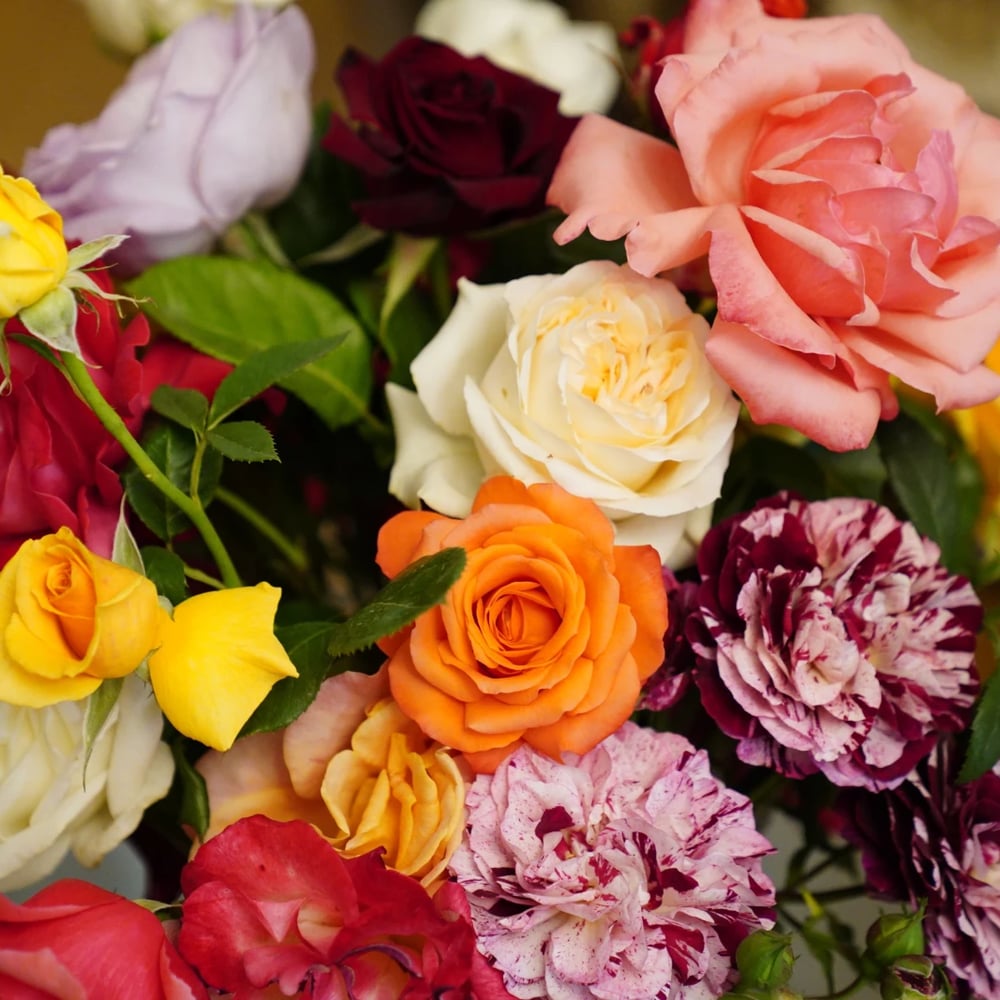
Species roses are the oldest types of roses, growing wild long before anyone bred them. Fossil hunters at Florissant Fossil Beds in Colorado found rose leaf impressions about 35 million years old. Most species roses carry five petals. They bloom once in late spring and produce bright hips rich in vitamin C.
North America has its own natives. Rosa setigera, the prairie rose, climbs fences across the eastern and central states. Rosa virginiana and Rosa carolina grow along roadsides from Maine to Texas. Rosa rugosa comes from East Asia, yet beach roses now cover the dunes of Cape Cod. Rugosas shrug off salt spray and survive winters in USDA zone 2.
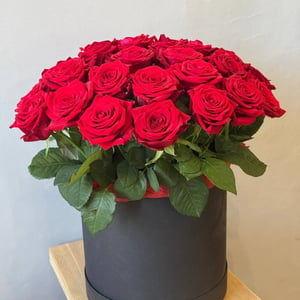
Old garden roses (before 1867)
Old garden roses include all types of roses that belonged to a recognized class before 1867. That year, French breeder Jean-Baptiste Guillot introduced 'La France,' and the ARS treats that rose as the dividing line between old and modern. Old roses usually smell stronger than modern ones, and many bloom only once. Still, a few classes repeat their bloom through fall.
| Class | Origin and era | Bloom habit | Variety to know |
|---|---|---|---|
| Gallica | Europe, ancient | Once | 'Rosa Mundi' |
| Damask | Middle East, ancient | Once (one repeats) | 'Kazanlik' |
| Alba | Europe, medieval | Once | 'Maiden's Blush' |
| Centifolia | Netherlands, 1600s | Once | 'Fantin-Latour' |
| Moss | France, 1700s | Once | 'Common Moss' |
| China | China, reached Europe in the late 1700s | Repeat | 'Old Blush' |
| Tea | China, 1800s | Repeat | 'Lady Hillingdon' |
| Bourbon | Île Bourbon (Réunion), about 1817 | Repeat | 'Souvenir de la Malmaison' |
| Portland | England and France, about 1800 | Repeat | 'Comte de Chambord' |
| Noisette | Charleston, South Carolina, about 1811 | Repeat | 'Champneys' Pink Cluster' |
| Hybrid Perpetual | France, 1830s to 1880s | Repeat | 'Paul Neyron' |
China roses changed everything. Their genes gave European roses the ability to rebloom, and every repeat-blooming modern rose traces back to that cross.
The Noisette class has a distinctly American story. John Champneys, a rice planter in Charleston, crossed a China rose with a musk rose around 1811. His neighbor Philippe Noisette sent seedlings to his brother Louis in Paris, and Louis Noisette launched the class in Europe. Noisettes still thrive in the hot, humid Southeast.
Modern roses: the popular types after 1867
Modern roses cover all types of roses bred after 1867, and they fill most US garden centers today. Breeders focused on repeat bloom, long stems, and a wider color range. Fragrance sometimes lost out along the way.
Hybrid tea
Hybrid teas grow one large bloom per long stem, making them the classic florist rose. A typical hybrid tea flower holds 30 to 50 petals, and the plant reaches 3 to 5 feet. 'Peace' made history: Conard-Pyle introduced the yellow-and-pink rose in the US in 1945, on the day Berlin fell. 'Mister Lincoln' followed in 1964 and still tops red rose lists.
Floribunda
Floribundas carry flowers in clusters instead of one per stem, so a single plant can cover itself in color from June to frost. German breeder Reimer Kordes released 'Iceberg' in 1958, and many rosarians still rank it as the most reliable white rose ever bred.
Grandiflora
Grandifloras combine hybrid tea blooms with floribunda clusters. The ARS created the grandiflora class in 1954 for a single rose: 'Queen Elizabeth,' a tall pink variety from California breeder Walter Lammerts. Grandifloras often reach 6 feet.
Polyantha
Polyanthas stay low and bloom in big sprays of small flowers. 'The Fairy,' a soft pink polyantha from 1932, still edges thousands of American front walks. Polyanthas also handle partial shade better than most roses.
Miniature and miniflora
Miniature roses shrink everything: leaves, blooms, and plant size. Most minis stay under 24 inches. Ralph Moore of Visalia, California, bred hundreds of them, including the yellow 'Rise 'n' Shine' in 1977. The ARS added the miniflora class in 1999 for roses sized between minis and floribundas.
Climbing and rambling roses
Climbers grow stiff canes 8 to 15 feet long and often rebloom. 'New Dawn,' a blush-pink climber, earned US Plant Patent No. 1 in 1931. Ramblers grow longer, softer canes, often past 20 feet, and bloom once. Walter Van Fleet bred the rambler 'American Pillar' in 1902.
Types of shrub roses and garden roses for US yards
Shrub roses are the hardworking types of roses for busy American gardeners. They resist disease, need little pruning, and handle tough winters. Honestly, shrub roses are the right starting point for most first-time growers.
Landscape roses
William Radler, an amateur breeder from Milwaukee, Wisconsin, created the Knock Out rose. Conard-Pyle introduced 'Knock Out' in 2000, and it quickly became the best-selling rose in North America. Knock Outs bloom from spring to frost with almost no spraying. Drift roses stay 18 to 24 inches tall and work as flowering groundcover.
English roses
English rosarian David Austin crossed old garden roses with modern ones to get cupped, fragrant blooms on repeat-flowering shrubs. Austin released his first variety, 'Constance Spry,' in 1961. 'Graham Thomas' (1983) and 'Gertrude Jekyll' (1986) remain favorites.
Hardy roses for cold states
Canadian breeders at Agriculture and Agri-Food Canada developed the Explorer and Parkland series for prairie winters. Explorer roses such as 'John Cabot' survive zone 3. Dr. Griffith Buck of Iowa State University bred about 90 cold-hardy roses, including 'Carefree Beauty' in 1977. Gardeners in Minnesota, the Dakotas, and northern New England rely on these lines.
| Shrub group | USDA zones | Typical height | Best use |
|---|---|---|---|
| Knock Out | 5 to 11 | 3 to 4 ft | Low-care borders |
| Drift | 4 to 11 | 1.5 to 2 ft | Groundcover, slopes |
| English (David Austin) | 5 to 9 | 3 to 6 ft | Fragrance, cutting |
| Rugosa | 2 to 9 | 4 to 6 ft | Coastal hedges |
| Explorer and Parkland | 3 to 8 | 3 to 8 ft | Northern states |
| Buck roses | 4 to 8 | 3 to 5 ft | Midwest gardens |
Rose varieties by color: types of roses list with names
Color is how most people shop for types of roses, so the names below work at a nursery counter or in a florist's catalog. Each list mixes garden varieties with popular cut roses.
Red rose varieties
- 'Mister Lincoln': hybrid tea, 1964, velvet red, strong fragrance.
- 'Chrysler Imperial': hybrid tea, 1952, dark crimson, classic perfume.
- 'Olympiad': hybrid tea, 1984, bright red, the official rose of the Los Angeles Olympics.
- 'Don Juan': climber, 1958, deep red, repeat bloom on 10-foot canes.
- 'Freedom': cut rose, true red, the florist standard for Valentine's dozens.
Pink rose varieties
Different types of pink roses range from blush to hot magenta:
- 'Queen Elizabeth': grandiflora, 1954, clear pink, tall and vigorous.
- 'Bonica': shrub, 1981, the first shrub rose to win All-America Rose Selections (in 1987).
- 'Gertrude Jekyll': English rose, 1986, rich pink, intense old-rose scent.
- 'Pink Floyd': cut rose, hot pink, long vase life.
- 'Sweet Avalanche': cut rose, pastel pink, a favorite for Mother's Day.
White rose varieties
Different types of white roses go from pure snow to warm ivory:
- 'Iceberg': floribunda, 1958, pure white, nearly nonstop bloom.
- 'Pope John Paul II': hybrid tea, 2008, bright white, citrus fragrance.
- 'Madame Hardy': damask, 1832, white with a green button eye.
- 'Sally Holmes': hybrid musk, 1976, single ivory blooms in huge clusters.
- 'Playa Blanca': cut rose, crisp white, a top wedding choice.
Yellow rose varieties
- 'Julia Child': floribunda, 2004, butter yellow, licorice scent.
- 'Graham Thomas': English rose, 1983, deep golden cups.
- 'Midas Touch': hybrid tea, 1992, bright yellow, holds color in heat.
- 'Sunsprite': floribunda, 1977, lemon yellow, sweet fragrance.
- 'Brighton': cut rose, sunny yellow, popular for graduations.
Purple rose varieties
- 'Ebb Tide': floribunda, 2004, plum purple, clove scent.
- 'Angel Face': floribunda, 1968, ruffled lavender, strong perfume.
- 'Sterling Silver': hybrid tea, 1957, silvery lilac.
- 'Reine des Violettes': hybrid perpetual, 1860, violet, nearly thornless.
- 'Ocean Song': cut rose, soft lavender, common in pastel bouquets.
Quick fact: no true blue rose exists in nature. Japan's Suntory engineered 'Applause' with a pansy gene and launched the lavender-blue rose in 2009. Any bright blue rose in a shop got its color from dye.
Looking for valentines day?
Browse valentines day from local florists — hand-arranged and delivered fresh near your recipient.
Types of roses and their meanings
Types of roses and their meanings come mostly from Victorian floriography, the "language of flowers." Kate Greenaway's Language of Flowers (1884) helped spread these codes across English-speaking homes, and Americans still read roses much the same way today.
| Color | Traditional meaning | Good moment to send |
|---|---|---|
| Red | Romantic love, passion | Valentine's Day, anniversaries |
| Pink | Gratitude, admiration | Mother's Day, thank-yous |
| White | Purity, remembrance, new beginnings | Weddings, sympathy |
| Yellow | Friendship, joy | Birthdays, graduations |
| Lavender | Enchantment, love at first sight | First dates, milestones |
| Orange | Enthusiasm, energy | Promotions, congratulations |
| Peach | Appreciation, sincerity | Thank-you gifts, Thanksgiving hosts |
Heads up: Victorians tied yellow roses to jealousy. Modern Americans don't, but a mixed bouquet softens any doubt.
Matching types of roses to US holidays and occasions
The right types of roses depend on the date on your calendar. The Society of American Florists estimates that US growers and florists prepare roughly 250 million roses for Valentine's Day alone. Here's a quick seasonal guide:
- Valentine's Day (February 14): long-stem red hybrid teas, ideally 'Freedom' or 'Explorer' quality.
- Mother's Day (second Sunday in May): pink garden roses or English-style blooms with fragrance.
- Memorial Day (last Monday in May): white and red roses for remembrance.
- National Rose Month (June): a garden rose for someone who loves to plant.
- Graduation season (May and June): bright yellow roses for the grad.
- Fourth of July: red and white roses with blue delphinium, since natural blue roses don't exist.
- Sweetest Day (third Saturday in October): red or orange roses, especially across the Midwest.
- Thanksgiving (fourth Thursday in November): peach and orange roses for the host.
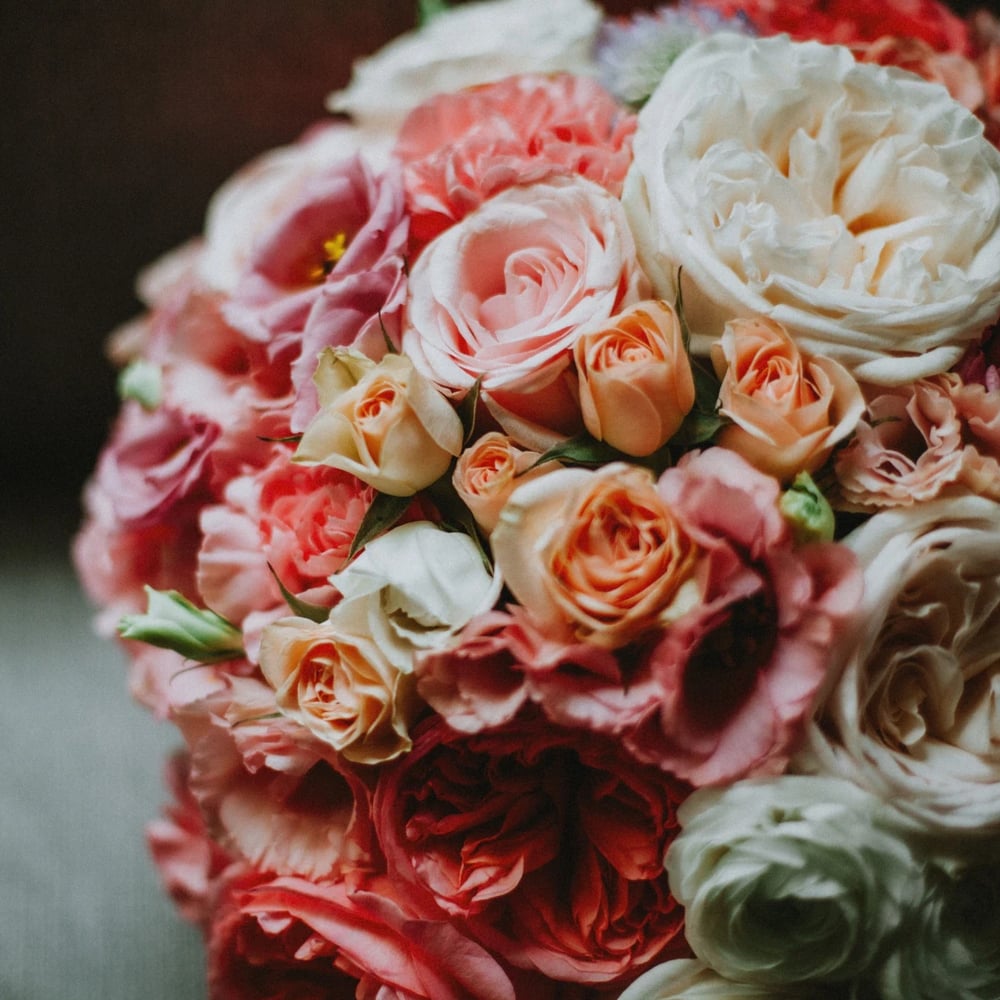
How to choose the right type of rose
Choosing between types of roses gets easier with a few simple checks. Garden roses and cut roses need different filters, so the list below covers both.
- Check your USDA hardiness zone before you buy any garden rose.
- Count sun hours: most roses need at least 6 hours of direct sun a day.
- Smell the bloom in person, because fragrance varies wildly within one class.
- Read the tag for disease resistance, especially in humid states like Georgia and Louisiana.
- Measure your space: a climber needs 8+ feet, and a mini fits a 12-inch pot.
- Ask your florist for cut roses with slightly open buds, which last 2 to 3 days longer.
Price matters too. A dozen long-stem red roses usually costs about USD 60 to 100, and the price climbs in the week before February 14.
How rose delivery works with local florists
Sending cut roses as a gift works best when a florist in your recipient's own city handles the order. You can order from anywhere in the US, yet the roses never travel across the country. Here's the process step by step:
- You pick a bouquet, a color, and a delivery date.
- You write a short card message for your recipient.
- A local florist in the recipient's city selects fresh roses and arranges the bouquet.
- A courier hand-delivers the bouquet to the door.
- You get a delivery confirmation, often with a photo.
Many local florists accept same-day orders placed before noon in the recipient's time zone. Ordering flower delivery in Chicago by noon CST, for example, usually gets roses to the door that afternoon.
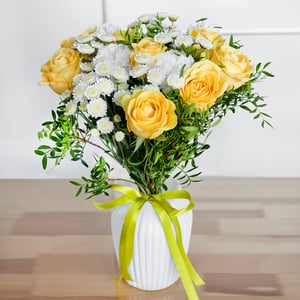
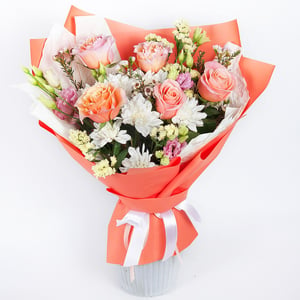
How to care for cut roses in any US climate
Cut roses last 7 to 10 days with good care, and a few habits make all the difference. Follow these steps the moment your bouquet arrives:
- Trim each stem 1 inch at a 45-degree angle under running water.
- Strip every leaf that would sit below the waterline.
- Add the flower food packet to clean, room-temperature water.
- Change the water every 2 days and recut the stems each time.
- Keep the vase in a room between 65°F and 72°F.
- Move the roses away from heating vents, sunny windows, and fruit bowls.
Climate changes the routine. In Phoenix or Las Vegas, dry air pulls moisture from petals, so check water levels daily. In Florida summers, bacteria grow faster, so change the water every day. Air conditioning helps, but cold drafts from a vent can shock buds.
Got a drooping head? Submerge the whole rose in warm water for 30 minutes, and the stem often straightens within an hour.
Planting garden roses instead? Plant bare-root roses in early spring and give each plant about 1 inch of water per week.
Common mistakes with types of roses
Most problems with roses come from a few predictable choices. Avoid these and you'll skip most of the frustration:
- Planting a hybrid tea in zone 4 without winter protection.
- Buying by photo alone, without checking fragrance or disease resistance.
- Watering leaves in the evening, which invites black spot.
- Placing cut roses next to ripening bananas, which release ethylene gas.
- Pruning once-blooming old roses in early spring, which removes that year's flowers.
- Choosing dyed blue roses for a garden gift, since the plant will bloom white.
Extras that make a rose gift feel personal
The roses you choose set the tone, and a few extras finish the message. Popular add-ons include:
- A handwritten card with 2 or 3 sentences that sound like you.
- A glass vase, so your recipient doesn't have to hunt for a pitcher.
- A box of chocolates for Valentine's Day or an anniversary.
- A photo confirmation, so you can see the bouquet at the door.
- A preserved rose, which keeps its color for a year or more.
Final thoughts on choosing types of roses
After years of comparing types of roses, here's my take: start with one rose that fits your life, not your wish list. For a garden, that might mean a 'Bonica' or a Knock Out by the mailbox. For a gift, pick a color with a clear message, like peach for a friend who helped you move. Which rose would make someone you care about smile this week? Browse a few bouquets, pick one color, and let a local florist handle the rest.
Send fresh flowers today
Pick a bouquet and a local florist hand-delivers it fresh to the door.