 EUR
 GBP
 CAD
 AUD

 🍂Thanksgiving Day🍂
 Birthday
 Occasions
 Flowers
 Roses
 Plants
 Gifts
 International Flower Delivery
Climbing roses: best varieties, planting, pruning, and care
- 🌹 Choose a climbing rose rated for your USDA zone, give the plant at least 6 hours of sun, and expect the real growth spurt in years 2 and 3.
- ✂️ Prune repeat-blooming climbers in late winter, when forsythia flowers. Prune once-blooming ramblers right after their early-summer flush.
- 🪢 Tie the main canes close to horizontal. Sideways canes push out short side shoots that carry most of the flowers.
Climbing roses can cover a 10-foot arbor in three seasons and produce blooms 4 to 6 inches wide from late May into October. Pick the right variety and prune at the right moment, and one plant turns a bare fence into the best view on your block. The catch is that most climbers sulk for the first year, and one badly timed winter cut can erase a whole season of flowers. This guide gives you more than 20 named varieties, a planting checklist, a pruning diagram, and a care calendar organized by USDA (U.S. Department of Agriculture) hardiness zone.
How climbing roses grow (and why year one feels slow)
Climbing roses don't actually climb on their own. Clematis uses tendrils and ivy uses aerial roots, but a rose has neither. You tie the long canes to a trellis, fence, or arbor, and the hooked prickles help the canes grip.
Rose growers sum up the timeline with an old saying: "The first year it sleeps, the second year it creeps, the third year it leaps." Heirloom Roses, an Oregon nursery, notes that many climbers bloom on old wood, meaning wood from the previous season. A first-year plant has very little old wood, so it often skips flowering or gives you only a handful of blooms. Patience pays off.
One distinction matters most: climbers and ramblers look alike in catalogs, but they behave very differently.
| Trait | Large-flowered climber | Rambler |
|---|---|---|
| Bloom size | 4–6 inches | 1–2 inches, in big clusters |
| Bloom cycle | Spring flush, then repeat flushes into fall | One heavy flush in late spring or early summer |
| Cane length | 8–15 feet | 15–30+ feet |
| Pruning window | Late winter | Right after flowering |
| Example | 'New Dawn' | 'American Pillar' |
Types of climbing roses
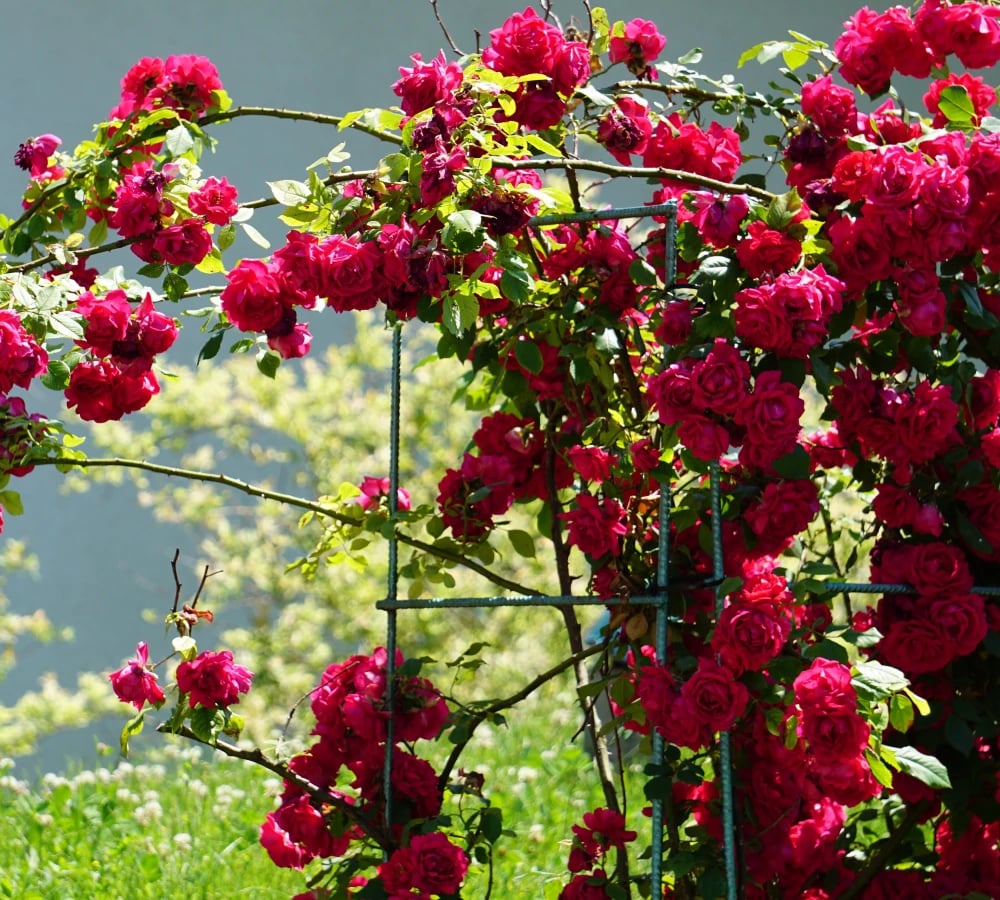
Climbing roses come from many family lines, and each line brings its own habits. The American Rose Society sorts climbers into several classes, and you'll see the class codes on nursery tags.
| Type | Tag code | What you get | Example |
|---|---|---|---|
| Large-flowered climber | LCl | Big blooms, repeat flowering, 8–15 ft canes | 'Don Juan' (1958) |
| Climbing sport | Cl HT, Cl F | A long-caned mutation of a bush rose | 'Climbing Iceberg' (1968) |
| Rambler | HWich, R | Huge once-a-year clusters, very vigorous | 'American Pillar' (1902) |
| Noisette | N | Fragrant clusters, heat-loving | 'Madame Alfred Carrière' (1879) |
| Bourbon climber | B | Rich old-rose scent, few or no prickles | 'Zéphirine Drouhin' (1868) |
| Hardy shrub climber | S | Cold tolerance down to zone 3 | 'William Baffin' (1983) |
| Species climber | Sp | Wild-type vigor, often thornless | Lady Banks rose (Rosa banksiae) |
Climbing sports vs. bred climbers
A climbing sport carries "Climbing" or "Cl." in its name. Nature produced 'Climbing Cécile Brünner' in 1894, when a bush 'Cécile Brünner' threw out a long-caned branch. Heirloom Roses points out that climbers without "Climbing" in the name come from crossing two parent roses. Bred climbers usually repeat-bloom better than sports.
An American original: the Noisette
Here's a fun fact for US gardeners. A rice planter named John Champneys raised 'Champneys' Pink Cluster' in Charleston, South Carolina, around 1811. That seedling launched the Noisette class, the first rose class born in the United States. Noisettes still thrive in the hot, humid South.
Ramblers for big structures
Dr. Walter Van Fleet, a USDA breeder, released 'American Pillar' in 1902. It covers a barn wall or a long fence with carmine-pink clusters every June. Ramblers suit spaces where you want volume rather than repeat flowers.








Best climbing roses: top climbing rose varieties by goal
The best climbing roses for your yard depend on your zone, your structure, and what you value most: scent, color, or easy handling. The table below lists reliable climbing rose varieties that US gardeners grow from Maine to California.
| Variety | Color | Height | USDA zones | Fragrance | Repeat bloom |
|---|---|---|---|---|---|
| 'New Dawn' (1930) | Pale blush pink | 12–20 ft | 5–9 | Light, fruity | Yes |
| 'Eden' (1985) | Cream and pink | 8–12 ft | 5–10 | Light | Yes |
| 'Don Juan' (1958) | Velvet red | 8–12 ft | 6–10 | Strong | Yes |
| 'Fourth of July' (1999) | Red-and-white stripes | 10–14 ft | 5–9 | Light apple | Yes |
| 'Golden Showers' (1957) | Yellow | 8–10 ft | 6–10 | Moderate | Yes |
| 'Peggy Martin' | Medium pink | 12–15 ft | 5–10 | Light | Yes |
| 'William Baffin' (1983) | Deep pink | 8–10 ft | 3–9 | Light | Yes |
| 'Zéphirine Drouhin' (1868) | Cerise pink | 8–12 ft | 5–9 | Strong | Yes |
'New Dawn' holds a historic first: the US Patent Office granted it Plant Patent No. 1 on August 18, 1931. Gardeners still rank 'New Dawn' among the toughest climbers for beginners.
Pink climbing rose varieties
Pink dominates the climber world, with shades ranging from shell pink to hot cerise. Each of these pink climbing rose varieties brings a different strength:
- 'New Dawn' opens pale blush flowers and tolerates partial shade.
- 'Eden' carries cupped, 4-inch blooms; the World Federation of Rose Societies voted 'Eden' the World's Favorite Rose in 2006.
- 'Zéphirine Drouhin' delivers cerise blooms, strong scent, and smooth canes.
- 'Kathleen Harrop' produces shell-pink flowers on thornless canes; Alex Dickson introduced it in 1919.
- 'Peggy Martin' survived Hurricane Katrina in 2005 under roughly 20 feet of saltwater in Plaquemines Parish, Louisiana.
- 'William Baffin' survives zone 3 winters and needs no winter protection.
- 'Climbing Cécile Brünner' covers 20 feet with tiny, perfectly shaped pink buds.
Most fragrant climbing roses
Fragrant climbing roses turn a front door or a patio arbor into a place where you stop and breathe in. Old Garden climbers usually beat modern ones on scent. These varieties rank among the most fragrant climbing roses you can grow:
- 'Madame Alfred Carrière' releases a sweet tea scent and tolerates north-facing walls.
- 'Zéphirine Drouhin' fills the air with a raspberry-damask perfume.
- 'Gertrude Jekyll' carries a classic old-rose fragrance; David Austin introduced it in 1986.
- 'Don Juan' pairs deep red petals with a heavy damask scent.
- 'Sombreuil' opens creamy, flat blooms with a tea fragrance and dates back to 1850.
- 'Climbing Étoile de Hollande' offers dark red, intensely perfumed flowers and dates from 1931.
Tip: smell climbers in the morning. Rose fragrance peaks before the afternoon heat burns off the scent oils.
Thornless climbing roses (and do climbing roses have thorns?)
Do climbing roses have thorns? Most do. Botanists call rose "thorns" prickles, because prickles grow from the stem's outer skin, while true thorns grow from wood. A handful of climbers carry few or no prickles, and these thornless climbing roses suit doorways, kids' play areas, and narrow paths:
- Lady Banks rose grows completely smooth canes and yellow or white clusters in zones 7–10.
- 'Zéphirine Drouhin' carries almost no prickles on its 8–12 foot canes.
- 'Kathleen Harrop' shares the smooth canes of its parent, 'Zéphirine Drouhin'.
- 'Peggy Martin' shows very few prickles and handles both Southern heat and zone 5 cold.
- 'Climbing Pinkie' offers nearly smooth stems and semi-double pink clusters and dates from 1952.
Honestly, "thornless" rarely means zero prickles, so wear gloves anyway when you tie canes.
Fast growing climbing roses
Fast growing climbing roses fill a pergola or hide an ugly wall within two or three seasons. The Lady Banks rose in Tombstone, Arizona, shows the extreme: settlers planted it in 1885, and the vine now shades more than 8,000 square feet. Here are the speed champions:
- Lady Banks rose adds 10 or more feet per season in warm zones.
- 'Kiftsgate' reaches 30–50 feet and swallows whole trees in zone 6 and warmer.
- 'Climbing Cécile Brünner' passes 20 feet in mild-winter regions.
- 'New Dawn' grows 12–20 feet and handles colder zones than the others.
- 'American Pillar' pushes 15–20 foot canes in a single season.
Fast growers need big, strong supports. A cheap metal obelisk will collapse under a 'Kiftsgate'.
Climbing roses for US holidays and occasions
Climbing roses fit naturally into the American calendar. On November 20, 1986, President Ronald Reagan signed the proclamation that made the rose the US national floral emblem. Here's how climbers match up with key dates:
| Occasion | Date | Climbing rose idea |
|---|---|---|
| Valentine's Day | February 14 | A bare-root 'Don Juan' for warm-zone gardeners, planted that week |
| Mother's Day | Second Sunday in May | A potted 'Eden' or 'New Dawn' in bloom, ready for the garden |
| Memorial Day | Last Monday in May | A planting weekend for zones 4–6, after the last frost |
| National Rose Month | June | Peak bloom season and a classic arbor backdrop for weddings |
| Independence Day | July 4 | 'Fourth of July', the first climber in 23 years to win the All-America Rose Selections award |
| Thanksgiving | Fourth Thursday in November | A fall-planting window for zones 8–10 |
Wedding arbors deserve a special note. Couples planning a June ceremony at home should plant a climber at least two springs ahead, because a one-year-old plant won't cover the arbor yet.
Looking for wedding?
Browse wedding from local florists — hand-arranged and delivered fresh near your recipient.
How to plant climbing roses
Climbing roses establish best in early spring after the last frost, or in fall about 6 weeks before the first hard freeze. In zones 8–10, you can also plant bare-root roses in January and February. Follow these steps:
- Choose a spot with at least 6 hours of direct sun; morning sun dries the leaves and cuts disease.
- Soak bare-root plants in a bucket of water for 12–24 hours before planting.
- Dig a hole about 18–24 inches wide and 18 inches deep.
- Place the hole 12–18 inches away from the wall or fence, so the roots escape the dry "rain shadow."
- Set the graft union 1–2 inches below the soil surface in zones 5 and colder, and level with the soil in warmer zones.
- Angle the canes toward the support at about 45 degrees.
- Backfill with native soil mixed with compost, then water slowly with 2–3 gallons.
- Spread 2–3 inches of mulch, keeping it 2 inches away from the canes.
Roses like slightly acidic soil, with a pH between 6.0 and 6.5. A $15 soil test kit from any garden center tells you where your bed stands.
Climbing roses care through the seasons
Climbing roses care comes down to water, food, training, and airflow. Your region changes the details, so adjust the calendar below to your local frost dates.
Watering and feeding
Give your climber about 1–2 inches of water per week, delivered at the base. Drip lines or soaker hoses keep the leaves dry. In Arizona, Texas, and inland California, summer heat often doubles that need.
Start feeding when new shoots reach about 6 inches long. A balanced rose fertilizer every 4–6 weeks works well for repeat bloomers. Stop feeding roughly 6 weeks before your first frost date; in Ohio or Pennsylvania, that usually means mid-August. Late feeding pushes soft growth that winter kills.
Training the canes
This is the trick that changes everything. A vertical cane flowers mostly at the tip. A horizontal cane sends up short side shoots, called laterals, along its whole length, and each lateral ends in a cluster of blooms.
Tie the canes as close to horizontal as your structure allows. Use soft ties, such as stretchy plant tape or strips of old T-shirts, and leave room for the cane to thicken. On a pillar or post, wrap the canes in a spiral.
Regional care notes
| Region | Main challenge | What you do |
|---|---|---|
| Southeast (Georgia, Florida, the Carolinas) | Humidity and black spot | Pick resistant varieties, water at 7–9 AM, rake fallen leaves |
| Southwest (Arizona, New Mexico) | Heat above 100°F | Add afternoon shade, mulch 3 inches deep, water deeply twice a week |
| Midwest and Northeast | Winters below 0°F | Grow zone 3–5 climbers, mound soil 10–12 inches over the base in late fall |
| Pacific Northwest | Wet springs and mildew | Space plants for airflow, choose 'New Dawn' or 'Eden' |
Black spot ranks as the most common climbing rose disease in the eastern US. Clean up every spotted leaf, because fungus spores overwinter in fallen foliage.
Pruning climbing roses: when and how
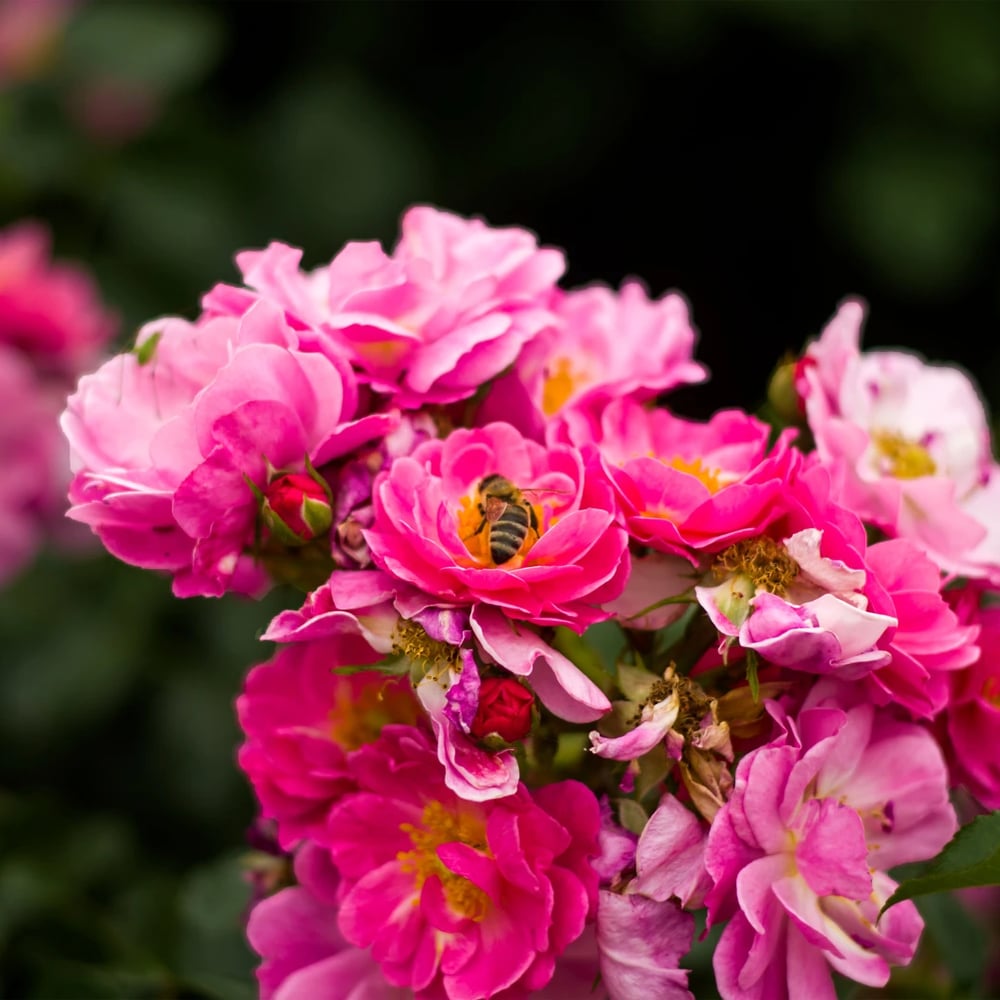
Pruning climbing roses scares many gardeners, but the method is simple once you know which canes to keep. Climbing roses flower on laterals that grow from older canes. Cut away too much old wood, and you cut away your flowers.
When to prune climbing roses
Timing depends on bloom habit and your zone. Watch the forsythia: when it flowers, roses wake up.
| Rose type | USDA zones 3–5 | Zones 6–7 | Zones 8–10 |
|---|---|---|---|
| Repeat-blooming climbers | April | March | January to February |
| Once-blooming ramblers | Right after flowering, June to July | Right after flowering, June | Right after flowering, May |
Leave new climbers alone for the first 2–3 years. During that time, remove only dead, broken, or diseased wood.
How to prune climbing roses: step by step
Grab sharp bypass pruners and a bottle of 70% isopropyl alcohol. Wipe the blades between plants to stop disease from spreading.
- Remove all dead, damaged, and diseased wood, cutting back to healthy white pith.
- Cut 1 or 2 of the oldest, grayest main canes down to the base every year from year 3 onward.
- Keep 4 to 6 strong young canes as the permanent framework.
- Shorten each lateral (side shoot) to 2 or 3 buds, roughly 3–6 inches long.
- Angle every cut at 45 degrees, about ¼ inch above an outward-facing bud.
- Retie the framework canes as close to horizontal as possible.
During the season, deadhead repeat bloomers by snipping spent flowers back to the first leaf with five leaflets. Stop deadheading about 8 weeks before your first frost so the rose can form hips and harden for winter.
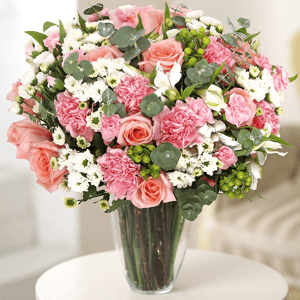
Caring for cut climbing roses after delivery
Climbing roses also make gorgeous cut flowers, especially garden-style varieties with old-rose scent. Cut climber blooms rarely appear in supermarket bouquets, but local florists often work with garden roses in June. When you send garden roses to someone you care about, a local florist in the recipient's city arranges the bouquet and hand-delivers it fresh.
Share these care steps with your recipient:
- Trim 1 inch off each stem at a 45-degree angle with a clean knife.
- Strip every leaf that sits below the waterline.
- Fill a clean vase with lukewarm water and add the flower food packet.
- Change the water every 2 days and re-trim the stems by ½ inch.
- Place the vase away from AC vents, direct sun, and fruit bowls.
Summer heat matters here. In Houston or Phoenix, room temperatures near a window can top 85°F, and garden roses wilt within 2 days in that spot. A cool hallway gives the same bouquet 5–7 days.




Common mistakes with climbing roses (and how to avoid them)
Climbing roses forgive a lot, but a few mistakes can cost you whole seasons of bloom. Watch for these:
- Hard pruning in year one. Young climbers need every cane; cut only dead wood for the first 2–3 years.
- Vertical training. Upright canes flower only at the tips; tie canes sideways for 3–4 times more laterals.
- Planting tight against a wall. Brick and siding block rain; leave a 12–18 inch gap.
- Pruning a rambler in winter. 'American Pillar' and other once-bloomers set buds on last year's wood; winter cuts remove the June show.
- Too much nitrogen. Heavy lawn fertilizer pushes leaves, not flowers; use a rose formula with a balanced ratio.
- Overhead evening watering. Leaves that stay wet overnight invite black spot; water at the base before 10 AM.
- The wrong zone. A zone 7 Noisette dies in a Minnesota winter; check the tag for your USDA zone first.
Extra ways to enjoy and share climbing roses
Climbing roses give you more than a pretty fence. Here are a few ideas for gifts and garden projects:
- A potted climber with an obelisk makes a Mother's Day gift that keeps growing for 20 years or more.
- A garden-rose bouquet from local florists brings June scent to a friend in another state.
- A handwritten card with pruning dates turns a plant gift into a plant your recipient can actually keep alive.
- Delivery photo confirmation shows you the bouquet at the door, which helps when you order from across the country.
- Softwood cuttings taken in June root in 6–8 weeks and make free plants for neighbors.
- Rose hips from unpruned climbers feed cardinals and other winter birds from November to February.
My take on climbing roses
Climbing roses reward one quality above all: patience. I've watched gardeners rip out a perfectly healthy 'New Dawn' after one quiet summer, when that same plant would have smothered the fence by year 3. Plant a variety that suits your zone. Tie the canes sideways. Then leave the pruners in the shed for two seasons.
So which structure in your yard needs a climber most: the bare mailbox post, the back fence, or the arbor nobody uses? Start with one plant this spring. And whenever you want rose scent sooner, ask local florists to put together a garden-rose bouquet for someone you love.
Send fresh flowers today
Pick a bouquet and a local florist hand-delivers it fresh to the door.