 EUR
EUR
 GBP
GBP
 CAD
CAD
 AUD
AUD

 🎃Halloween🎃
 Birthday
 Occasions
 Same Day
 Flowers
 Roses
Roses
 Plants
 Gifts
Gifts
 International Flower Delivery
Begonia Care: Rex, Angel Wing & Polka Dot Types
- 🌿 Most begonias thrive in bright indirect light, consistently moist (not soggy) soil, and humidity above 50% — get those three right, and you solve 90% of begonia problems.
- 🪴 Rex, angel wing, polka dot, and wax begonias each need slightly different watering schedules and light levels, so identify your variety before following generic advice.
- ✂️ Propagate most begonias through stem cuttings in water or perlite during spring, when rooting takes roughly 3–4 weeks.
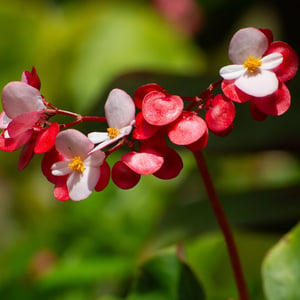
The begonia plant belongs to one of the largest flowering genera on Earth — over 2,000 species strong. That matters to you because, no matter your skill level, at least one begonia fits your home perfectly. Rex, angel wing, polka dot, wax, Rieger, ferox, escargot — each type has quirks worth knowing. This guide breaks down begonia care indoors and outdoors, covers propagation methods variety by variety, and flags the mistakes that kill more begonias than neglect ever could. Grab your watering can. Let's dig in.
How to grow begonias indoors: the fundamentals
Begonia care indoors starts with understanding what these plants need at a basic level. Wild begonias grow on tropical forest floors across Central America, South America, and Southeast Asia. Your living room mimics that environment — partially.
Begonia light requirements
Begonias need bright, indirect light for 6–8 hours daily. East-facing windows work best in most U.S. homes. South-facing windows? Pull the plant 3–4 feet back from the glass, or hang a sheer curtain.
Direct afternoon sun scorches begonia leaves within days. That goes double for rex begonias and polka dot begonias, whose thin leaves burn fast.
Low light causes leggy growth. The stems stretch. Flowering varieties stop blooming entirely. A north-facing window rarely provides enough light — supplement with a grow light set to roughly 2,000 lux for 10–12 hours.
Begonia watering: how much and how often
Begonia watering trips up more growers than any other care step. Here's the rule: water when the top inch of soil feels dry. Stick your finger in. Dry? Water thoroughly until liquid drains from the bottom holes. Wet? Wait another day or two.
Overwatering causes root rot faster than underwatering causes wilt. During winter months (November through February in most of the U.S.), most begonias need water only once every 10–14 days. In summer, expect to water every 5–7 days.
Key watering guidelines:
- Use room-temperature water — cold water shocks tropical roots
- Avoid wetting the leaves, especially on rex and tuberous types
- Empty saucers within 30 minutes to prevent standing water
- Switch to bottom watering for fuzzy-leaved varieties like Begonia rex 'Escargot'
Soil, humidity, and temperature
Begonias demand a well-draining potting mix. Combine 2 parts peat-based mix, 1 part perlite, and 1 part orchid bark. This blend holds moisture without staying waterlogged.
Humidity should stay between 50% and 70%. Most U.S. homes drop to 30–40% in winter when central heating runs. A small humidifier near the plant solves this problem. Pebble trays help, though they raise humidity by only about 5%.
Keep room temperature between 65°F and 75°F. Begonias suffer below 55°F. Never place a begonia near a drafty window or HVAC vent.
Indoor begonia varieties: picking the right one for your space
Indoor begonia types range from compact 6-inch wax begonias to towering 5-foot angel wing canes. Your choice depends on available light, space, and whether you want flowers or foliage.
Rex begonia care
Rex begonia care revolves around foliage, not flowers. Begonia rex cultivars — sometimes called "painted leaf" begonias — display swirls of silver, purple, pink, and green. The variety 'Escargot' spirals its leaves into a snail-shell shape. Stunning stuff.
Rex begonias prefer slightly lower light than other types. Bright filtered light works. Direct sun fades the leaf colors. Keep humidity above 55%; rex begonias drop leaves fast in dry air.
Water rex begonias sparingly. The rhizomes store moisture. Let the top 1–1.5 inches of soil dry between waterings. Overwatered rex begonias develop powdery mildew almost immediately.
Fertilize rex begonias every 4 weeks during the growing season (April through September) with a balanced liquid fertilizer diluted to half strength.
Angel wing begonia care
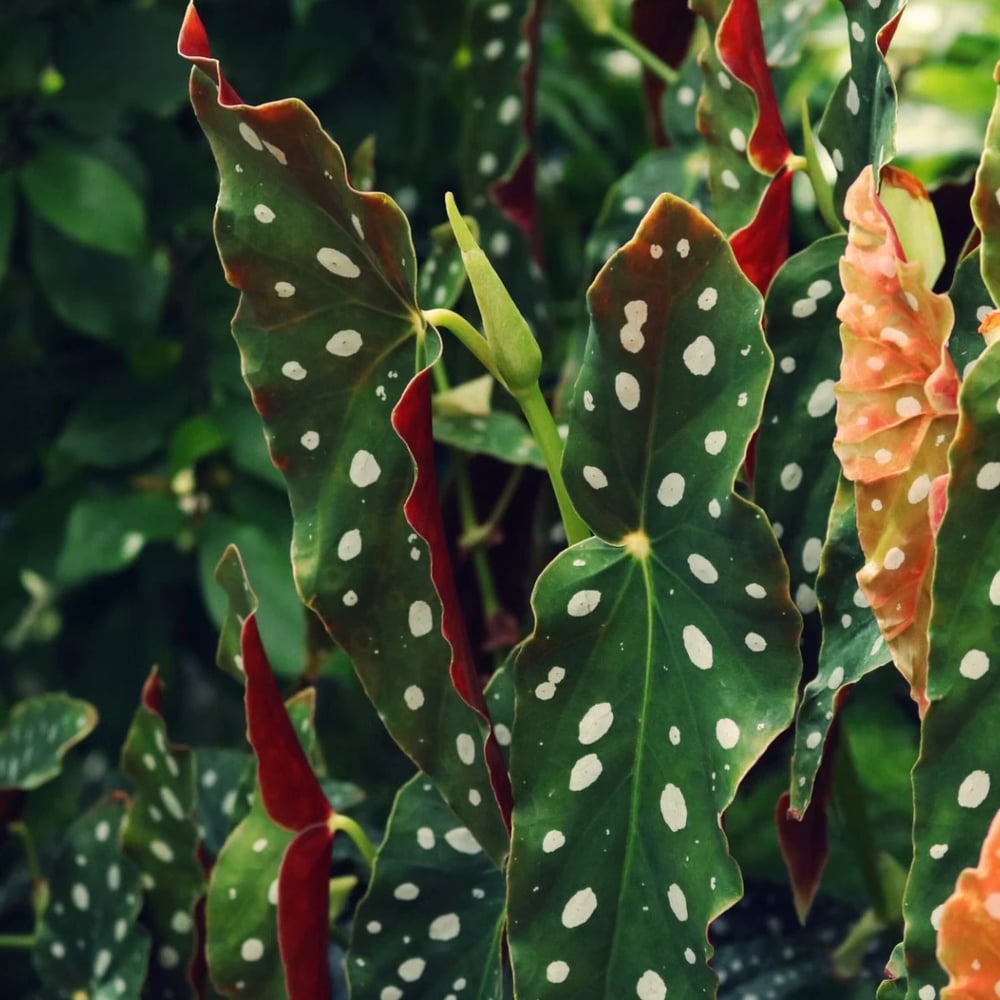
Angel wing begonia care centers on managing height. Cane-type begonias grow tall — often 2–4 feet indoors. The angel-shaped leaves sprout on bamboo-like stems and frequently show silver speckles on top with red undersides.
Give angel wing begonias brighter light than rex types. An east or west window works well. These begonias bloom in spring and summer, producing dangling clusters of red, pink, or white flowers.
Pinch the growing tips in early spring. This encourages bushier growth and prevents the "all stem, no leaf" look.
Angel wing begonias tolerate slightly drier air than rex begonias. Aim for 45% humidity or above.
Polka dot begonia care (Begonia maculata)
Begonia maculata care demands attention to humidity — this variety sulks in dry rooms. The polka dot begonia features olive-green leaves covered in silver spots, with deep crimson undersides. It grows as a cane-type begonia, reaching 12–18 inches indoors.
Spotted begonia care specifics:
- Place the plant in bright indirect light, 4–6 feet from a south window
- Water when the top inch dries — roughly every 6–8 days in summer
- Maintain humidity at 60% or above
- Rotate the pot a quarter turn each week to prevent lopsided growth
- Prune leggy stems back to a leaf node in spring
Begonia maculata blooms with small white flower clusters from late spring through early fall. Remove spent flowers promptly — the plant redirects energy toward leaf production.
Wax begonia care
Wax begonias (Begonia semperflorens) tolerate more sun than any other begonia group. These compact plants reach 6–12 inches tall and flower continuously from late spring through the first frost.
Outdoor gardeners across USDA Zones 10–11 grow wax begonias as perennials. Everywhere else in the U.S., treat wax begonias as annuals or bring them inside before temperatures dip below 50°F.
Wax begonia care indoors is straightforward. Give the plant at least 4 hours of direct morning light. Water when the soil surface dries. Fertilize every 2–3 weeks with a diluted 10-10-10 formula.
Rieger begonia care
Rieger begonias (also called Elatior begonias) bloom spectacularly — rose-like double flowers in yellow, orange, red, pink, or white. Growers breed Rieger begonias as short-day plants, meaning they flower most heavily in fall and winter when daylight hours drop below 12.
Rieger begonia care differs from other types in one key way: avoid overwatering at all costs. Rieger begonias have unusually rot-prone stems. Let the soil dry 2 inches deep between waterings.
Keep Rieger begonias in bright indirect light. These begonias rarely last more than 1–2 seasons indoors because the tubers exhaust themselves. Many growers treat Rieger begonias as gift plants — enjoy the bloom, then compost.
Begonia ferox care
Begonia ferox stands out for its textured, almost spiky-looking leaves covered in dark raised bumps. This Vietnamese species stays compact — 8–12 inches tall — and prefers terrarium-like conditions.
Ferox begonias need high humidity: 70% minimum. Temperatures between 65°F and 80°F suit the plant best. Water carefully and infrequently; the shallow root system rots quickly.
Begonia ferox grows slowly. Expect 2–3 new leaves per month during the growing season. This begonia rarely blooms indoors.
Beefsteak begonia care
Beefsteak begonia (Begonia erythrophylla) gets its name from the red undersides of its round, fleshy leaves. This rhizomatous begonia grows 12–16 inches tall and spreads outward.
Beefsteak begonia care is forgiving. The plant tolerates lower light than most begonias, handles average household humidity (40–50%), and needs water only when the top 2 inches of soil dry out. Perfect for beginners.
Begonia escargot plant
The Begonia escargot plant — a rex begonia cultivar — features tightly spiraled leaves in silver and green. Leaves reach 4–6 inches across. Care follows standard rex begonia guidelines: moderate light, high humidity, careful watering.
One tip specific to the escargot variety: avoid misting directly on the spiral center. Water pools in the curl and promotes fungal growth.







Begonia care instructions: seasonal guide
Begonia plant care shifts with the seasons. U.S. growers face unique challenges depending on climate zone and time of year.
Spring (March–May)
Spring marks the start of active growth. Repot root-bound begonias into containers 1–2 inches wider. Begin fertilizing. Resume a regular watering schedule as temperatures climb.
This window is also prime time for propagation (more on that below).
Summer (June–August)
Begonias grow fastest during summer months. Water more frequently — sometimes every 4–5 days for cane types. Watch for pests: mealybugs, spider mites, and fungus gnats thrive in warm weather.
Move outdoor begonias to shadier spots when afternoon temperatures exceed 90°F. Heat stress causes leaf drop.
Fall (September–November)
Reduce watering gradually. Stop fertilizing by mid-October. Bring outdoor begonias inside before nighttime temperatures fall below 50°F.
Rieger begonias hit peak bloom. Rex begonias may enter a brief dormancy period — leaf drop is normal.
Winter (December–February)
Begonia care indoors during winter means less water, no fertilizer, and extra attention to humidity. Central heating dries out indoor air rapidly. Run a humidifier or group tropical plants together to create a micro-humid zone.
Avoid placing begonias near radiators, fireplaces, or heating vents.
How to propagate begonias: method by variety
Propagation multiplies your collection for free. Different begonia types require different approaches.
Polka dot begonia propagation
Polka dot begonia propagation works best through stem cuttings. Cut a 4–6 inch stem just below a leaf node using clean scissors. Remove the lowest 2 leaves. Place the cutting in water or moist perlite. Roots appear within 3–4 weeks. Transfer the rooted cutting to soil once roots reach 1–2 inches long.
Angel wing begonia propagation
Angel wing begonia propagation follows the same stem-cutting method. Choose a healthy stem with at least 2 nodes. Dip the cut end in rooting hormone for faster results — studies show rooting hormone reduces rooting time by roughly 30%.
Water propagation in a clear glass jar lets you monitor root growth directly.
Rex begonia propagation
Rex begonia propagation uses leaf cuttings — a unique method. Cut a healthy leaf from the mother plant. Flip the leaf upside down and make 1-inch cuts across the major veins using a sterile blade. Place the leaf vein-side-down on moist vermiculite. Pin the leaf flat with toothpicks or small stones.
Cover the tray with plastic wrap to trap humidity. Tiny plantlets emerge at each vein cut within 4–6 weeks. Separate the plantlets when they grow 2–3 leaves each.
Begonia maculata propagation
Begonia maculata propagation mirrors polka dot begonia propagation (same plant, different common name). Stem cuttings root reliably in both water and sphagnum moss. Spring propagation yields the highest success rate — roughly 85% under proper conditions.
Love low-maintenance greenery like begonias?
Browse easy-care potted plants that bring the same lush look to any room.
Common begonia mistakes and how to fix them
Begonia care instructions often skip the failures. Here are the biggest ones U.S. growers make.
Overwatering
Symptom: yellowing lower leaves, mushy stems, soil that smells sour. Fix the problem by removing the plant from wet soil immediately. Trim any black or mushy roots with sterilized scissors. Repot into fresh, dry mix. Wait 3–5 days before watering again.
Too much direct sun
Symptom: brown, crispy leaf edges; bleached-out colors on rex types. Move the plant farther from the window or add a sheer curtain. Damaged leaves won't recover, but new growth will emerge healthy.
Low humidity
Symptom: leaf edges curl inward; brown tips appear; new leaves emerge smaller than usual. Buy a hygrometer (under $10 at most hardware stores) and track your room's humidity. A tabletop humidifier rated for 200–400 square feet handles most rooms.
Ignoring pests
Begonias attract mealybugs, spider mites, and fungus gnats. Check the undersides of leaves weekly. Treat mealybugs with rubbing alcohol on a cotton swab. Combat spider mites with neem oil spray (dilute 2 teaspoons of cold-pressed neem oil per quart of water). Control fungus gnats by letting the soil dry out more between waterings and topping the surface with a half-inch layer of sand.
Using the wrong pot
Begonias perform better in slightly snug pots. A container too large holds excess moisture around the roots. Choose a pot no more than 2 inches wider than the root ball. Always use a pot with drainage holes — no exceptions.
Begonia light requirements: a quick reference chart
Different begonia types need different amounts of light. This table simplifies begonia care for every variety discussed.
| Variety | Light level | Direct sun tolerance | Ideal window |
|---|---|---|---|
| Rex begonia | Medium indirect | None | North or filtered east |
| Angel wing begonia | Bright indirect | 1–2 hours morning sun | East or west |
| Polka dot begonia | Bright indirect | None | East, set back 4–6 ft from south |
| Wax begonia | Bright to direct | 4+ hours morning sun | South or east |
| Rieger begonia | Bright indirect | 1 hour gentle morning sun | East |
| Begonia ferox | Low to medium | None | North or terrarium |
| Beefsteak begonia | Low to medium indirect | None | North or east |
| Escargot begonia | Medium indirect | None | North or filtered east |
Begonia flower plant: getting your begonias to bloom
Not every begonia blooms readily indoors. Foliage types like rex begonias rarely flower — and honestly, you don't want the flowers. Rex blooms steal energy from the spectacular leaves. Pinch off rex flower stalks when they appear.
Flowering begonias — angel wing, wax, and Rieger — need specific conditions to bloom:
- Give the plant at least 6 hours of bright indirect light daily
- Fertilize with a bloom-boosting formula (higher phosphorus, like 10-30-20) every 2 weeks during spring and summer
- Maintain nighttime temperatures 5–10°F cooler than daytime
- Avoid moving the plant once buds form — begonias drop buds when relocated
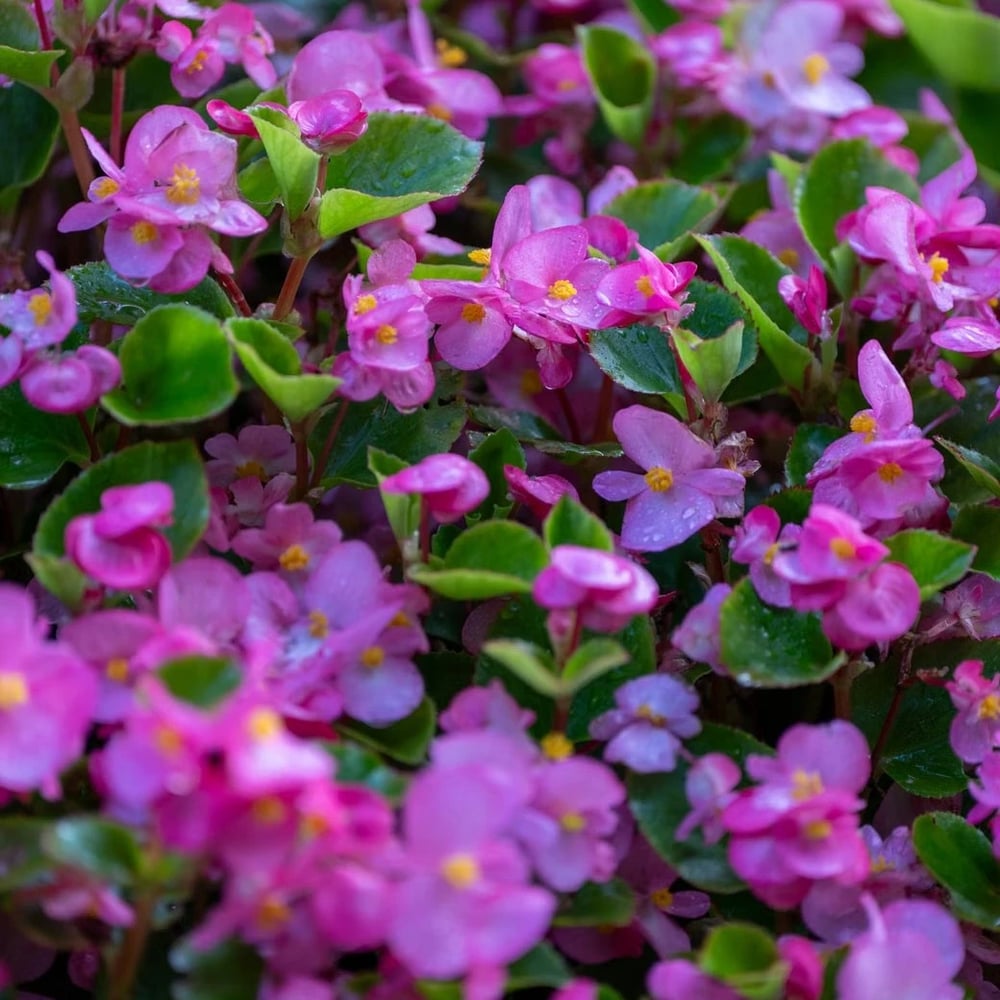
Wax begonias bloom most freely. A well-fed wax begonia flowers continuously from May through October in most U.S. climates.
Begonia house plant gifts: a growing trend
Begonia indoor plants make excellent gifts for houseplant lovers. They're showier than pothos, hardier than calathea, and available in more varieties than almost any other genus.
Popular occasions for gifting begonias in the U.S.:
- Mother's Day (second Sunday in May) — a rex begonia in a decorative pot makes a lasting alternative to cut flowers
- Housewarming parties — wax begonias and angel wings adapt quickly to new environments
- Teacher Appreciation Week (first full week of May) — a compact polka dot begonia fits on a desk
- Holiday gifts (November–December) — Rieger begonias bloom during the holiday season, bringing color to short winter days
When you order a begonia plant as a gift, local florists often deliver the plant in a decorative container, ready to display. That personal touch matters.
Your next move
You now know more about begonia care than 95% of indoor gardeners. Here's what I'd suggest: pick one variety — just one — and commit to learning its rhythm over the next 3 months. Track when you water, how the leaves respond, what the soil looks like when the plant is thirsty. That observation teaches you more than any guide can.
Which begonia caught your eye? Start there.
Know someone settling into a new home?
A living plant makes a housewarming gift that keeps growing long after moving day.