 EUR
 GBP
 CAD
 AUD

 🍂Thanksgiving Day🍂
 Birthday
 Occasions
 Flowers
 Roses
 Plants
 Gifts
 International Flower Delivery
Flower arrangement at home: how to arrange flowers like a florist
- 🌿 A strong flower arrangement starts with one focal flower, uses filler and greenery for support, and rises 1.5 to 2 times the vase height above the rim.
- ✂️ Cut every stem at a 45-degree angle, strip the leaves below the waterline, and change the water every 2 days to keep blooms fresh for a week or longer.
- 🌸 Japanese ikebana shows that 5 well-placed stems and open space can look more refined than a crowded vase.
A smart flower arrangement can turn a $15 grocery store bouquet into something that looks like a $90 florist design. All you need is a clean vase and about 20 minutes. This guide covers how to arrange flowers in a vase, how to build a hand-tied bouquet, and how ikebana, the Japanese art of flower arrangement, uses empty space. You'll also find holiday ideas for Mother's Day and Thanksgiving, plus care tips for humid Miami and dry Phoenix.
Flower arrangement basics: the four building blocks
Every flower arrangement relies on the same four ingredients, whether it's a $12 Trader Joe's bunch or a $200 wedding centerpiece. Learn these four, and you'll know how to arrange flowers of any kind.
- Focal flowers draw the eye first: roses, peonies, sunflowers, or dahlias.
- Secondary flowers add volume in a supporting color: spray roses, carnations, or lisianthus.
- Filler flowers close the gaps with small blooms: baby's breath, waxflower, or statice.
- Greenery frames the design and hides the stems: eucalyptus, ruscus, or salal.
Many florists start with a rough ratio of 1 part focal flowers, 2 parts secondary flowers, and 3 parts filler and greenery. That ratio keeps a vase full without burying your best blooms.
Proportion, color, and odd numbers
Proportion decides whether a vase looks balanced or awkward. Let the flowers rise 1.5 to 2 times the vase height above the rim. A 6-inch vase, for example, pairs well with blooms that stand 9 to 12 inches above the rim.
Odd numbers look more natural. Designers group focal blooms in 3s, 5s, or 7s, while even groups tend to read as stiff rows.
For color, borrow the 60-30-10 rule from interior designers. Give 60% of the arrangement to a dominant color, 30% to a secondary shade, and 10% to an accent. Picture blush roses, cream lisianthus, and a few deep burgundy ranunculus.
How to make a flower arrangement in 8 steps
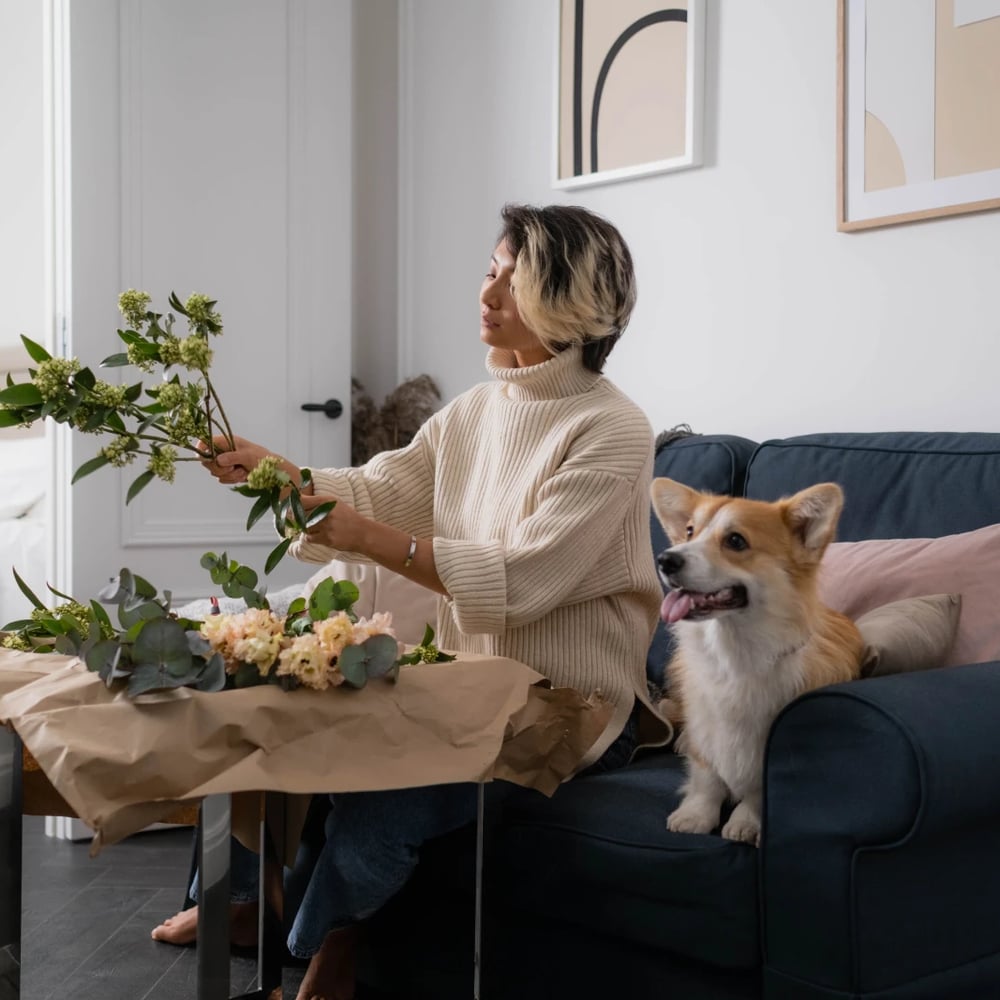
A flower arrangement comes together in 20 to 30 minutes once you follow a clear order. Here's the process florists use every day:
- Wash the vase with hot water and a drop of dish soap to kill bacteria.
- Fill the vase two-thirds full with lukewarm water, about 100°F, and stir in one flower food packet.
- Strip every leaf that would sit below the waterline.
- Cut each stem at a 45-degree angle, removing 1 to 2 inches with sharp shears.
- Build a base of greenery, crisscrossing the stems to form a natural grid.
- Add the focal flowers next, placing the tallest one slightly off-center.
- Fill the gaps with secondary and filler flowers, turning the vase as you work.
- Step back about 6 feet and check the shape from every side.
Quick tip: cut stems under running water or in a bowl of water. An air bubble can block a stem within seconds and stop water from reaching the bloom.
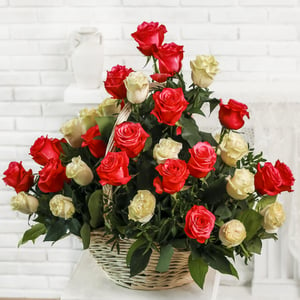
How to arrange flowers in a vase
Learning how to arrange flowers in a vase starts with the vase itself, because the opening controls how your flower arrangement falls. A narrow neck pulls stems upright, while a wide mouth lets them flop outward.
| Vase shape | Typical height | Best flowers | Styling tip |
|---|---|---|---|
| Cylinder | 8–10 inches | Tulips, calla lilies, gladiolus | Let long stems lean slightly |
| Fluted (trumpet) | 7–9 inches | Garden roses, hydrangeas | The flare spreads stems for you |
| Bud vase | 4–6 inches | One rose, ranunculus, sweet pea | Use 1 to 3 stems |
| Low bowl or compote | 4–6 inches | Peonies, garden roses, greenery | Keep the total under 12 inches for dinner tables |
| Square cube | 4–6 inches | Hydrangeas, short roses | Wrap a leaf inside to hide stems |
How to arrange flowers in a vase professionally
Professional florists rarely let stems drift around. Most lay clear floral tape across the vase mouth in a tic-tac-toe pattern, with strips about 1 inch apart. Each square holds 2 or 3 stems upright, and the greenery hides the tape.
For wide bowls, florists crumple a 12-by-12-inch piece of chicken wire into the vessel. Many designers have dropped floral foam because it sheds microplastics and never breaks down. Chicken wire does the same job, and you can reuse it for years.
Here's another pro move: let a few sprigs of greenery drape over the rim. That one detail makes a $4 glass cylinder look intentional.
How to arrange a bouquet of flowers in a vase
A store-bought bouquet usually holds 15 to 25 stems wrapped in cellophane and a rubber band. You can keep the existing design: hold the bunch tight, cut the band, and trim all the stems together by 1 inch.
Choose a vase that reaches about one-third of the bouquet's total height. Then drop the bundle in and loosen the outer stems with your fingers. Want more polish? Pull out the stems one by one and follow the 8 steps above. That's how to arrange fresh flowers in a vase so a grocery bunch looks custom.
Looking for mothers day?
Browse mothers day from local florists — hand-arranged and delivered fresh near your recipient.
How to arrange flowers in a bouquet (hand-tied spiral)
A hand-tied flower arrangement uses the spiral technique, one of the first skills most floral design courses teach. The spiral looks tricky, but honestly, two or three practice rounds get you there. Here's how to arrange a bouquet of flowers by hand:
- Strip all leaves from the bottom two-thirds of each stem.
- Hold one focal stem upright in your non-dominant hand, about 5 to 7 inches below the bloom.
- Add each new stem at a 45-degree angle, always slanting in the same direction.
- Rotate the bouquet a quarter turn after every 3 or 4 stems.
- Tie the binding point tightly with jute twine or a rubber band.
- Trim the stems to an even length of about 10 to 12 inches.
The spiral matters. Angled stems fan out at the bottom, so the bouquet stands on its own and water reaches every stem. Place the finished bouquet in a vase and recut each stem at an angle.
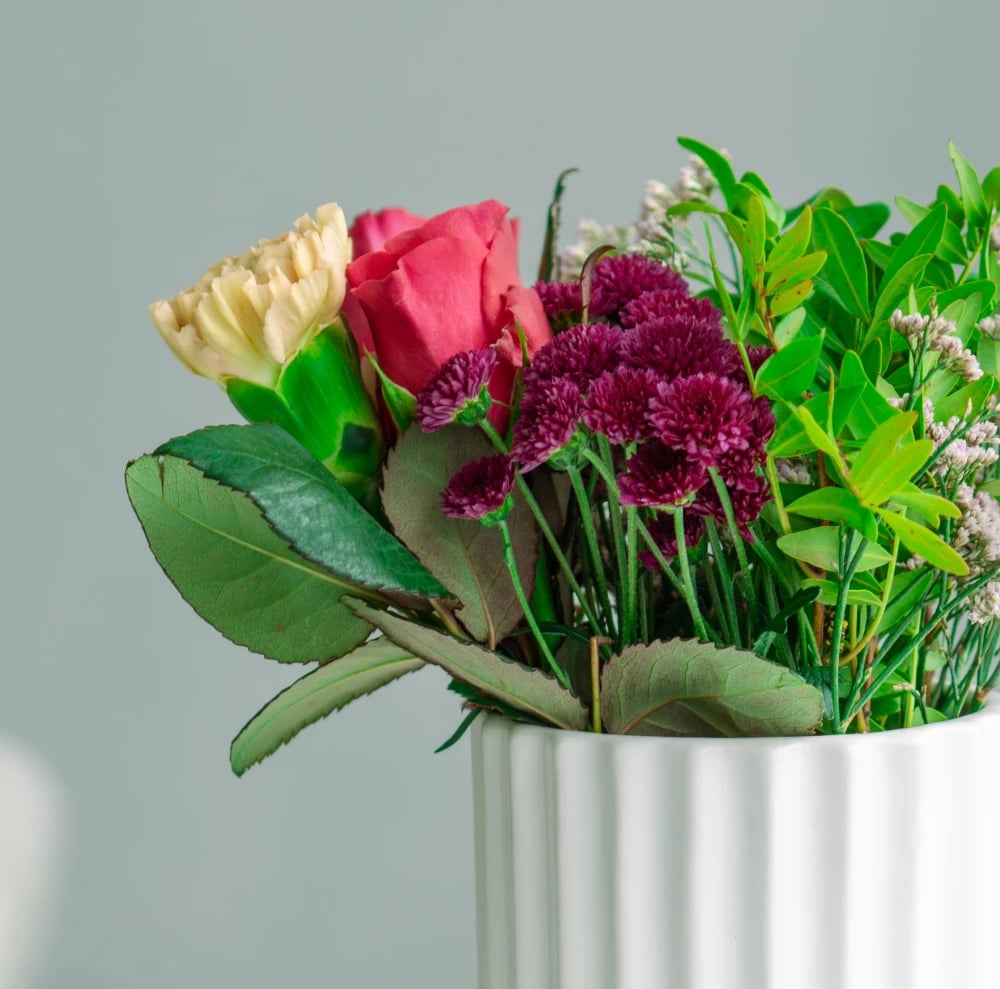
Japanese flower arrangement: the art of ikebana
Japanese flower arrangement, or ikebana, treats each stem as a line in a drawing rather than a dot of color. The word combines ikeru (to keep alive) and hana (flower). Buddhist monks placed flowers on temple altars in Japan as early as the 6th century. The Ikenobo school, which operates from Rokkakudo Temple in Kyoto, traces its written records back to 1462.
Four principles shape an ikebana flower arrangement:
- Asymmetry replaces the round, full shape of Western bouquets.
- Empty space, or ma, gives each stem visual room.
- Seasonality guides material choice: cherry branches in April, maple leaves in November.
- Line matters more than mass, so branches and bare stems often lead the design.
Major ikebana schools
| School | Founded | Style focus |
|---|---|---|
| Ikenobo | Records from 1462, Kyoto | Classical forms like rikka and shoka |
| Ohara | Late 1800s, by Unshin Ohara | Moribana in shallow containers, landscape scenes |
| Sogetsu | 1927, by Sofu Teshigahara | Freestyle designs with modern materials |
By the way, you don't need to travel to Japan to learn. Ikebana International, which American Ellen Gordon Allen founded in Tokyo in 1956, runs chapters in dozens of US cities.
How to make an ikebana flower arrangement at home
The Sogetsu basic upright style works well for beginners. You need a shallow dish about 10 inches wide and 2 inches deep, plus a kenzan, or pin frog, which costs $10 to $25. Sogetsu teachers size the main stem at 1.5 times the dish width plus depth: (10 + 2) × 1.5 = 18 inches.
- Place the kenzan in the front left of the dish and add water to cover the pins.
- Cut the shin, or heaven stem, to 18 inches and tilt it 10 to 15 degrees to the left.
- Cut the soe, or human stem, to about 13 inches and tilt it 45 degrees to the left.
- Cut the hikae, or earth stem, to about 10 inches and angle it 75 degrees forward to the right.
- Add 2 or 3 short filler stems to hide the kenzan, then stop.
Ikebana rewards restraint. Five stems can look complete, and the urge to keep adding is exactly the habit you're unlearning.
Flower arrangement ideas for US holidays and occasions
A seasonal flower arrangement feels personal because it matches the calendar your recipient already lives by. These flower arrangement ideas follow major US dates:
| Occasion | Date | Flowers | Arrangement idea |
|---|---|---|---|
| Valentine's Day | February 14 | Red roses, ranunculus, tulips | Low cluster of 12 roses in a cube vase |
| Easter | A Sunday in March or April | Tulips, daffodils, hyacinths | Loose pastel jar arrangement |
| Mother's Day | Second Sunday in May | Peonies, garden roses, lilies | Soft pink garden-style vase |
| Memorial Day and July 4 | Last Monday in May; July 4 | Red carnations, white hydrangeas, blue delphinium | Red, white, and blue mason jar |
| Graduation | May–June | Sunflowers, blooms in school colors | Bouquet in the school's colors |
| Thanksgiving | Fourth Thursday in November | Orange roses, mums, wheat, dried leaves | Long, low centerpiece under 12 inches |
| Christmas | December 25 | Amaryllis, red roses, pine, cedar | Evergreen centerpiece with candles |
| Sympathy | Any time | White lilies, roses, orchids | All-white vase or standing spray |
Valentine's Day creates the biggest rush of the year. The Society of American Florists estimates that growers produce about 250 million roses for that single day. Order 5 to 7 days ahead for February 14 and Mother's Day, when florists book up fast.
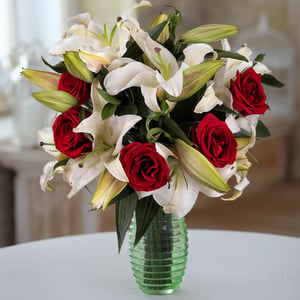
Simple flower arrangement ideas that take 10 minutes
A simple flower arrangement often looks more stylish than a busy one, especially when it uses a single flower type. Try one of these this weekend:
- A monobotanical vase: 15 to 20 tulips in a clear cylinder.
- A bud vase lineup: 5 small vases, each holding one stem, down a dining table.
- A herb jar: rosemary, mint, and basil in a mason jar on the kitchen counter.
- A floating bowl: 3 gardenia or rose heads in a 10-inch bowl of water.
- A single branch: one 30-inch cherry or forsythia branch in a tall vase.
- A grocery makeover: a $15 bouquet split into 3 small jars for different rooms.
Flower arrangement care: keep blooms fresh in any US climate
A flower arrangement lasts 5 to 10 days on average, and your daily habits decide which end of that range you get. Follow these steps from day one:
- Change the water every 2 days, or daily in hot weather.
- Trim ½ inch from each stem at every water change.
- Keep the vase between 65°F and 72°F, out of direct sun.
- Move the arrangement away from fruit bowls, since ripening bananas and apples release ethylene gas that ages petals faster.
- Remove wilted blooms right away to slow bacteria.
- Chill the arrangement overnight in the coolest room of the house, or in the fridge if there's no fruit inside, to slow down aging between viewings.
Climate tips for humid Miami and dry Phoenix
In humid Miami, bacteria grow fast in warm vase water. Change the water daily, wash the vase each time, and keep the arrangement in an air-conditioned room away from sunny windows.
In dry Phoenix, flowers lose moisture through their petals quickly. Top up the vase every day, keep the arrangement away from AC vents and direct sun, and mist delicate blooms like hydrangeas lightly with water.
With the right building blocks, a clear process, and a few minutes of care each day, any flower arrangement you make at home can look and last like a florist's design.
Send fresh flowers today
Pick a bouquet and a local florist hand-delivers it fresh to the door.