EUR
 GBP
 CAD
 AUD

 ✨Boss’s Day✨
 🍭Sweetest Day🍭
 Birthday
 Same Day
 Occasions
 Flowers
 Roses
 Plants
 Gifts
 International Flower Delivery
Daffodil Flower Meaning & Symbolism
- 🌼 Daffodil meaning centers on rebirth, hope, and new beginnings — rooted in the flower's habit of blooming among the first signs of spring, often as early as late February.
- 📖 Different colors shift the message: yellow daffodils signal joy and friendship, white ones suggest purity, and orange varieties express enthusiasm or creative energy.
- 🎁 Give daffodils for March birthdays, 10th anniversaries, cancer-awareness events, or any moment that calls for optimism — but always gift a bunch, because a single stem can mean misfortune in some traditions.
Daffodil meaning goes far beyond "pretty yellow flower." Over 13 centuries of folklore, poetry, and cultural tradition have shaped how people read this bloom — and those readings still influence the bouquets you send today. Whether you're choosing a March birthday gift, honoring a 10th wedding anniversary, or simply curious about why a single golden trumpet stirs so much emotion, this guide breaks down every layer of daffodil symbolism. You'll walk away knowing exactly what a daffodil says — and when to say it with one.
What does a daffodil symbolize? The core ideas

Daffodil symbolism rests on a handful of powerful themes. The flower belongs to the genus Narcissus, which includes roughly 50 wild species and more than 27,000 registered cultivars. Botanists classify daffodils within the Amaryllidaceae family. Their trumpet-shaped corona and six petal-like tepals make daffodils one of the most recognizable blooms on the planet.
So what does a daffodil symbolize at the deepest level?
- Rebirth and renewal — daffodils push through cold soil in late winter, sometimes blooming as early as February in USDA zones 8–9
- Hope and resilience — the American Cancer Society adopted the daffodil in 2009 as its signature symbol for "Daffodil Days," raising awareness and funds every March
- Unrequited love and self-reflection — drawn directly from the Greek myth of Narcissus
- Prosperity and good luck — Chinese New Year celebrations treat Narcissus tazetta (the Chinese sacred lily) as a harbinger of wealth when the flower blooms on New Year's Day
Each of these threads has its own history. Let's pull them apart.
Daffodil flower meaning across colors
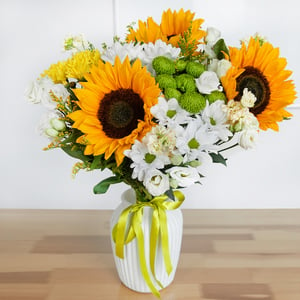
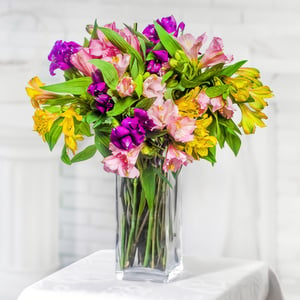
Daffodil flower meaning shifts depending on the petal and corona color. Here's a quick reference:
| Color | Meaning | Best occasion |
|---|---|---|
| Yellow | Joy, friendship, optimism | Birthday, congratulations, "just because" |
| White | Purity, fresh starts, remembrance | Sympathy, wedding, Easter |
| Orange/Peach | Enthusiasm, vitality, creative energy | Housewarming, graduation |
| Bicolor (yellow + white) | Balance, harmony | Anniversary, thank-you gift |
| Pink-tinted | Gentle affection, femininity | Mother's Day (second Sunday of May in the U.S.) |
Yellow daffodil meaning
Yellow daffodil meaning dominates the conversation — roughly 75% of commercial daffodil cultivars sport some shade of gold. That golden hue mirrors sunlight, and human psychology links yellow to happiness and warmth. Gifting a bunch of 10 or 12 yellow daffodils sends an unmistakable message: "I'm thinking of you, and the future looks bright."
White and orange varieties
White daffodils — varieties like 'Thalia' and 'Mount Hood' — carry a quieter tone. Florists often include white daffodils in sympathy arrangements or Easter centerpieces. Orange-cupped cultivars like 'Professor Einstein' and 'Chromacolor' add a punch of energy. Consider orange daffodils for a friend launching a new business or a student finishing finals.
Daffodil spiritual meaning and inner symbolism
Daffodil spiritual meaning draws from multiple traditions. Let's walk through them.
Christian symbolism: the Lent lily
In England, the common daffodil (Narcissus pseudonarcissus) goes by "Lent lily." The bloom's timing lines up neatly with Lent, the 40-day period before Easter. Churches across the American South — particularly in Virginia, where naturalized daffodils carpet old church grounds — still use daffodils in Easter altar displays. The spiritual meaning of daffodils here points toward resurrection and divine grace.
Eastern spiritual traditions
Chinese families place Narcissus tazetta bulbs in shallow bowls of water and pebbles 4–6 weeks before Lunar New Year. The goal: coax the blooms open by New Year's Day. A bulb that flowers on time promises a full year of good fortune. In Persian culture, the narcissus (known as narges) appears in Hafez's 14th-century poetry as a symbol of the beloved's eyes — linking the flower to spiritual longing and awareness.
Modern spiritual readings
Contemporary practitioners associate daffodils with the solar plexus chakra, the energy center linked to confidence and personal power. The flower's trumpet shape mirrors the idea of "opening up" — projecting your voice, claiming your space. That interpretation resonates with anyone navigating a tough transition or reclaiming their sense of self.
Daffodils in Greek mythology: the Narcissus story

You can't discuss daffodil symbolism without Narcissus. Ovid's Metamorphoses (written around 8 AD) tells the famous tale. The young hunter Narcissus rejected the nymph Echo. As punishment, the goddess Nemesis led Narcissus to a pool where he fell in love with his own reflection. Unable to leave, Narcissus wasted away. A flower — the narcissus — grew in his place.
That myth gives daffodils a dual edge. On one hand: self-love, vanity, ego. On the other: the danger of isolation, the cost of rejecting connection. Victorian-era floriographers leaned into this tension. Charlotte de Latour's 1819 book Le Langage des Fleurs assigned the narcissus a meaning of egotism. Later editions softened the entry to "self-esteem" and "respect."
Honest take: most modern gift-givers don't worry about the Narcissus baggage. A bright bouquet of daffodils reads as cheerful — period. But the myth adds a layer of depth worth knowing.
Cultural meaning of daffodils around the world
Wales: the national flower
Wales adopted the daffodil as a national emblem alongside the leek. Welsh people wear daffodils on St. David's Day, March 1st. The tradition gained momentum in the 19th century when David Lloyd George, later Prime Minister of the United Kingdom, championed the daffodil over the leek for public ceremonies.
Japan: quiet respect
Japanese culture links the narcissus (suisen) to quiet dignity and respect. The flower appears frequently in ikebana (traditional flower arranging) during the New Year period.
United States: cancer awareness and March birthdays
The American Cancer Society's "Daffodil Days" campaign has distributed millions of daffodil bunches since the 1970s. Schools, workplaces, and community groups across the U.S. buy daffodils each March to raise money for cancer research. That connection makes daffodils a powerful gift for survivors, caregivers, and anyone touched by the disease.
The daffodil also serves as the official birth flower for March. A March baby receiving daffodils on a birthday gets a gift that feels personal and seasonally tuned.
When to give daffodils: occasions and etiquette
Daffodils fit a surprising range of moments. Here are the strongest matches:
- 10th wedding anniversaries — traditional floral guides assign the daffodil to year ten
- March birthdays — the official birth flower of the month
- Easter and springtime gatherings — a classic centerpiece bloom
- Get-well wishes — the cheerful color lifts spirits without the intensity of red roses
- Cancer-related events — Relay for Life, survivorship celebrations, memorial tributes
- Housewarming parties — daffodils signal fresh starts and new chapters
One important etiquette note
Never give a single daffodil. In many folk traditions — especially British and Welsh — a lone daffodil predicts misfortune. Always give a bunch. Even a modest group of 5–7 stems avoids the superstition and looks far more generous.
The Victorian language of flowers: what daffodils meant in the 1800s
Welcome spring with a flower that means new beginnings
Daffodils are a natural choice when the message is optimism, renewal, or a fresh start.
Victorian floriography turned every petal into a coded message. The practice peaked between 1830 and 1880 in both England and the United States. During that era, a gentleman couldn't hand a bouquet to a lady without considering every bloom's dictionary entry.
Daffodils meant "regard" or "unrequited love" in most floriography guides. Some dictionaries split the species further:
- Narcissus jonquilla (jonquil) → "desire" or "affection returned"
- Narcissus poeticus (pheasant's eye) → "self-love" or "egotism"
- Narcissus pseudonarcissus (common daffodil) → "respect" or "chivalry"
The jonquil distinction matters. Many people use "daffodil" and "jonquil" interchangeably, but Victorian flower dictionaries treated them as separate entries with separate meanings. Kate Greenaway's 1884 Language of Flowers listed the jonquil under "I desire a return of affection" — a far more romantic note than the standard daffodil meaning.
How to care for fresh daffodils at home
Daffodils last 5–10 days in a vase. Follow these steps to maximize their life, especially in warmer U.S. climates where room temperatures run higher.
- Cut 1 inch off each stem at a 45-degree angle using a sharp knife — avoid scissors, which crush the fibers
- Place the stems in cool water (about 65 °F) right away
- Keep daffodils in their own vase for the first 6–12 hours — the stems release a sap (mucilage) that shortens the life of other flowers
- Change the water every 2 days and re-trim the stems each time
- Set the vase away from direct sunlight, heating vents, and fruit bowls — ethylene gas from ripening fruit accelerates wilting
- Add a packet of commercial flower food or mix ¼ teaspoon of bleach into every quart of water to curb bacterial growth
A common mistake to avoid
Many people mix freshly cut daffodils with tulips or roses in the same vase immediately. That sap kills companion flowers fast. Let the daffodils "condition" alone first. After 12 hours, rinse the stems under running water, then combine them with other blooms. The sap stops leaking after that initial period.
Daffodils in literature and art
William Wordsworth's 1804 poem "I Wandered Lonely as a Cloud" remains the most famous literary tribute to daffodils. Wordsworth described seeing a "host of golden daffodils" along the shore of Ullswater in England's Lake District during an April 1802 walk with his sister Dorothy. Dorothy's journal entry from that day — April 15, 1802 — captured the scene in vivid detail and likely inspired William's poem.
American poet Robert Herrick referenced daffodils in his 1648 poem "To Daffodils," using the flower's short blooming season as a metaphor for the brevity of life. The poem's famous lines — "We have short time to stay, as you" — still appear on sympathy cards and memorial programs today.
In visual art, daffodils show up in Dutch Golden Age still-life paintings from the 1600s. Artists like Ambrosius Bosschaert the Elder included narcissus blooms alongside tulips and irises to represent the fleeting nature of beauty — a theme called vanitas.
Daffodils as gifts: pairing ideas and extras
A bouquet of daffodils works well on its own. It also pairs beautifully with complementary blooms and extras:
- Daffodils + tulips — a classic spring duo (remember to condition the daffodils separately first)
- Daffodils + hyacinths — a fragrant, textured pairing
- Daffodils + a handwritten card — the most personal touch you can add costs nothing
- Daffodils + a scented candle — great for housewarming gifts or get-well packages
When ordering daffodils for delivery within the U.S., local florists typically assemble and hand-deliver arrangements the same day. Place your order before noon in the recipient's time zone to maximize the chance of same-day arrival.
Why a single daffodil can mean bad luck
This superstition deserves its own spotlight. In Welsh and broader British folklore, gifting one daffodil invites disappointment or even death into the household. The belief may trace back to the medieval idea that the first daffodil you spot in spring predicts your year — a single bloom meant a lean harvest, while a cluster promised abundance.
Practically speaking, a lone stem looks sparse anyway. A bundle of at least 5 stems makes a stronger visual and emotional impact. You avoid the superstition and create a fuller gift at the same time.
Your next move
Ready to send some sunshine?
Choose a bright bouquet that turns a springtime message into a gift they can see and enjoy.
Daffodil meaning touches mythology, medicine, art, spirituality, and everyday kindness. That's a lot of weight for a flower that costs roughly $1–$2 per stem at most U.S. grocery stores during peak March season. Knowing the story behind the bloom makes your gift more thoughtful — and gives you a great conversation starter when someone asks, "Why daffodils?"
So here's a question for you: who in your life could use a burst of golden optimism right now? Pick up a bunch this spring and see how much a simple flower can say.