EUR
 GBP
 CAD
 AUD

 🎃Halloween🎃
 Birthday
 Occasions
 Same Day
 Flowers
 Roses
 Plants
 Gifts
 International Flower Delivery
Sympathy card message: what to write when words feel impossible
- ✉️ A strong sympathy card message names the person who died, shares one specific memory or quality, and keeps the total note under 4 sentences.
- ✍️ Avoid fixing grief with phrases like "everything happens for a reason" — acknowledge the pain instead of explaining it away.
- 💐 Send your card within 2 weeks of the loss, and pair it with a concrete offer of help rather than a vague "let me know."
A sympathy card message can take you 30 seconds to read — and stay with a grieving person for years. That single sentence you scribble inside a card carries more weight than most people realize. Roughly 2.8 million Americans lose a loved one each year, according to CDC mortality data. Each of those losses creates a ripple — friends, neighbors, coworkers, and distant relatives who all face the same blank card and the same question: what do I actually write? You're here because you want your words to land with genuine comfort, not hollow cliché. This guide gives you ready-to-use examples, practical writing tips, and honest advice on phrases to avoid.
How to write a sympathy card in 4 clear steps
Writing a sympathy card message feels hard because the stakes feel enormous. Good news: you don't need poetry. You need sincerity and structure. Follow these 4 steps, and your note will read as genuine every time.
Step 1: Open with a direct acknowledgment
- Start by naming the loss. Don't dance around death with euphemisms like "passed on to a better place." A direct opening respects the reader's intelligence.
- "I'm so sorry about the loss of your mother, Linda."
- "My heart broke when I heard about David's death."
- "I was deeply saddened to learn that James passed away."
Notice the pattern: each opener names the person who died. According to grief counselor Megan Devine, author of It's OK That You're Not OK (2017), using the deceased person's name shows the bereaved that their loved one matters to you — not just as a concept, but as a real human being.
Step 2: Share a specific memory or quality
- A generic sympathy card message says "they were a wonderful person." A meaningful one explains why. Even a single detail transforms your card.
- "I'll always remember how Tom greeted everyone at the door with that big laugh."
- "Your dad taught me how to change a tire in 1998, and I've never forgotten his patience."
- "Maria made the best arroz con pollo at every family gathering — she fed our whole block."
- Don't worry about length here. One sentence with a concrete detail outweighs three sentences of vague praise.
Step 3: Offer support — be specific
- "Let me know if you need anything" puts the burden on the grieving person. Flip the script. Offer something concrete.
- "I'm dropping off dinner on Thursday around 6 PM — no need to reply."
- "I'll pick up the kids from soccer practice next Tuesday."
- "I'd love to mow your lawn this Saturday morning."
- "I'm free Wednesday and Friday afternoons to help with errands."
- Grief researcher Katherine Shear, MD, at Columbia University, has noted that practical support reduces the isolation bereaved people feel during the first 30 days after a loss.
Step 4: Close with warmth
- End your sympathy card note with a short, warm sign-off. Keep the closing under 10 words.
- "With love and deep sympathy, [Your name]"
- "Thinking of you always, [Your name]"
- "With all my heart, [Your name]"
- "In shared sorrow, [Your name]"
- "Holding you close in thought, [Your name]"

Simple sympathy card messages you can use right now
- Sometimes you need words for a sympathy card fast. Maybe the funeral is tomorrow. Maybe you just bought the card at CVS 15 minutes ago. Here are 12 short messages — each under 25 words — ready to copy.
- "I'm so sorry for your loss. [Name] meant so much to everyone who knew them."
- "No words can ease your pain, but please know I'm here."
- "Thinking of you during this incredibly difficult time. You're not alone."
- "My heart goes out to you and your family. [Name] will always be remembered."
- "I wish I could take away your pain. Sending you all my love."
- "Your [mom/dad/friend] touched so many lives. The world is dimmer without them."
- "Please accept my deepest condolences. I'm just a phone call away."
- "[Name] was one of a kind. I'm grateful I got to know them."
- "There are no right words, but my love for you is steady."
- "I'm holding you in my thoughts every single day."
- "Wishing you moments of peace in the middle of this grief."
- "Sending you strength, love, and a shoulder whenever you need one."
- These work well for acquaintances, neighbors, or coworkers — situations where you care but don't share deep history with the grieving person.







Sympathy card messages for specific types of loss
A sympathy card message for someone who lost a parent hits differently than one for a colleague who lost a pet. Here's how to adjust your wording based on the relationship.
Loss of a parent
- Losing a mother or father reshapes a person's identity. Over 6 million American adults lose a parent each year, according to the American Psychological Association (APA). Your words should honor the magnitude of that shift.
- "Your mother raised an incredible person. Her love lives on in everything you do."
- "I remember your dad's voice booming across the yard every Fourth of July. That joy was contagious."
- "Losing a parent changes the whole world. I'm standing with you through this change."
- "Your father was proud of you — he told me so at Thanksgiving last year."
- "Your mom's kindness shaped our entire neighborhood. I'll miss her deeply."
Loss of a spouse or partner
- The death of a spouse eliminates a daily companion. About 900,000 Americans become widowed every year. These words acknowledge that particular void.
- "I can only imagine how quiet the house feels right now. I'm coming over Saturday."
- "[Name] loved you fiercely. That love doesn't end — it just changes shape."
- "You built a beautiful life together. I'm honored I got to witness parts of it."
- "I'll bring coffee and sit with you whenever you want company. Or silence. Both are fine."
Loss of a child
- No sympathy card message can match this grief. Keep your note brief and honest. Don't try to find a silver lining. There isn't one.
- "I have no words big enough for this loss. I'm here, and I'm not going anywhere."
- "[Name] lit up every room. I will carry that light forward."
- "Your love for [Name] was extraordinary. Nothing changes that — not even this."
Loss of a friend
- Friendship losses often get overlooked. Society tends to prioritize family grief, but losing a close friend can hit just as hard.
- "[Name] was the friend everyone deserves but few people find. I'm so sorry."
- "I know [Name] meant the world to you. Your grief matters."
- "Friends like [Name] don't come around twice. I'll remember them right alongside you."
Loss of a pet
About 67% of U.S. households — roughly 85 million families — own a pet, according to the American Pet Products Association (2023–2024 survey). Dismissing pet grief as "less than" human grief alienates people who just lost a family member with four legs.
- "[Pet's name] gave you 12 years of unconditional love. That bond was real."
- "I'm sorry about [Pet's name]. Your home won't feel the same for a while."
- "No one can replace [Pet's name]. I know how much that little face meant to you."
Condolence sympathy card messages for the workplace
- Writing a sympathy card note for a coworker or boss requires a different tone. You want warmth without overstepping professional boundaries. Keep the message between 1 and 3 sentences.
- "On behalf of our entire team, please accept our sincere condolences. We're thinking of you."
- "I'm so sorry for your loss. Take all the time you need — we'll handle things here."
- "Your family is in our thoughts. Please don't worry about work right now."
- "[Name] clearly raised a remarkable person. Our team is here for you."
- "We know no card can fix this, but we want you to know we care deeply."
- Hallmark's business division recommends that companies send sympathy cards within 3 business days of learning about the loss. A card signed by the whole department carries more emotional weight than a solo email.
Sympathy card phrases and sayings by tone
Your relationship with the bereaved person shapes your tone. Here's a breakdown by emotional register.
Warm and personal
"I loved the way [Name] always called me 'kiddo,' even after I turned 40."
"Your family welcomed me like their own. I grieve with you."
Formal and respectful
"Please accept my deepest sympathy during this time of sorrow."
"My sincere condolences to you and your entire family."
Religious or spiritual
- Only include faith-based sentiments when you know the bereaved person shares that faith. Otherwise, you risk adding discomfort.
- "May God wrap you in peace during this painful season."
- "I believe [Name] rests in the arms of the Lord now."
- "Praying for your family's comfort and healing."
Secular and universal
"The love you shared with [Name] doesn't disappear. It echoes."
"Grief is love with nowhere to go. I'm here to sit with you in it."
Sending your message with flowers?
Browse arrangements from local florists and pick one that suits the occasion.
What NOT to write in a sympathy card
- Sympathy card wording can go wrong fast. Here are 7 phrases to strike from your vocabulary — and why.
- "Everything happens for a reason." This minimizes the loss. Grief doesn't need a justification.
- "They're in a better place." You don't know the person's beliefs. Skip the assumption.
- "I know exactly how you feel." You don't. Even similar losses produce different grief.
- "At least they lived a long life." Length doesn't reduce the pain of losing someone.
- "Stay strong." Grief demands vulnerability, not performance.
- "God needed another angel." This can feel cruel to someone questioning their faith.
- "You'll get over it eventually." Grief doesn't follow a timeline. The American Grief Institute emphasizes that grief transforms rather than disappears.
- A safe rule: read your card aloud before sealing the envelope. Ask yourself, "Would I want to hear this sentence on the worst day of my life?" The answer tells you everything.

When and how to send your sympathy card
Timing matters. Sympathy card etiquette in the U.S. follows a general guideline: send your card within 2 weeks of learning about the death. Here's a quick framework.
| Timing | Best for |
|---|---|
| Within 1–3 days | Close family and friends |
| Within 1 week | Extended family, neighbors |
| Within 2 weeks | Coworkers, acquaintances |
| Up to 1 year | Late-arriving news, anniversary notes |
A sympathy card that arrives 3 months late still matters. Many bereaved people say the cards that arrive after the initial flood of attention mean the most — because everyone else has moved on.
Handwritten vs. printed
Handwrite your card. A 2019 study published in the Journal of Experimental Social Psychology found that recipients value handwritten notes more than typed ones, perceiving them as more effortful and sincere. Even sloppy handwriting beats a printed font.
Pair your card with a gesture
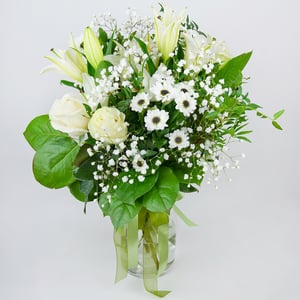
Many people send sympathy flowers alongside a card. White lilies, chrysanthemums, and roses remain the most common choices in the U.S. for funeral and condolence arrangements. Local florists assemble and deliver these arrangements the same day in most metro areas.
- You can also pair your card with:
- A home-cooked meal or gift card to a local restaurant
- A donation to a charity the deceased cared about
- A book on grief (Megan Devine's It's OK That You're Not OK is a popular choice)
- A framed photo of the deceased
Sympathy card message ideas for tough situations
Some losses don't fit neatly into a category. Here's how to handle 4 of the trickiest.
You didn't know the deceased
- Keep your sympathy card message focused on the living person. You don't need to pretend you knew someone you didn't.
- "I didn't have the chance to meet [Name], but I can see how deeply you loved them."
- "Anyone who raised someone as kind as you must have been extraordinary."
The death was sudden or tragic
- Sudden loss — car accidents, heart attacks, overdoses — leaves no time for goodbyes. Acknowledge the shock directly.
- "I can't imagine the shock you're feeling. No one should have to absorb this."
- "This is devastating and unfair. I'm angry and sad alongside you."
You haven't spoken in years
- Reconnecting through a sympathy card is completely appropriate. Don't apologize for the gap — just show up.
- "We haven't talked in a while, but I wanted you to know I'm thinking of you."
- "Distance and time don't change the fact that I care. I'm sorry for your loss."
The relationship was complicated
- Not every parent-child bond was healthy. Not every marriage was happy. Tread carefully.
- "I know your relationship with [Name] was complicated. Your feelings right now — all of them — are valid."
- "Grief doesn't always look the way people expect. Whatever you're feeling, I respect it."






A step-by-step template for your sympathy card note
- Still stuck? Use this fill-in-the-blank framework. The whole note takes about 45 seconds to write.
- Line 1 (Acknowledge): "Dear [Name], I'm so sorry about [deceased person's name]'s passing."
- Line 2 (Memory or quality): "I'll always remember [specific detail — a laugh, a recipe, a habit, a story]."
- Line 3 (Offer): "I'm [specific action — bringing dinner Tuesday, calling you this weekend, mowing your lawn Saturday]."
- Line 4 (Close): "With love, [Your name]"
- Total word count: 35–50 words. That's all you need.
Your words matter more than you think
A blank sympathy card sitting on your kitchen counter can feel like a 500-pound weight. Here's the truth: the person receiving your card won't judge your prose style. That person won't grade your grammar. That person will feel — maybe for just a moment — slightly less alone.
Write the imperfect sentence. Seal the envelope. Drop the card in the mail today. And if you want to send sympathy flowers along with your note, browse arrangements from local florists who deliver the same day in most U.S. cities.
What's the most meaningful sympathy card you ever received — and what made those words stick?
Send sympathy flowers
Choose your bouquet, add a message, and let a local florist hand-deliver it.
FAQ
What is the best short sympathy card message?▾
"I'm so sorry for your loss. [Name] meant so much, and I'm thinking of you." This message works for nearly every situation because it names the deceased, acknowledges the pain, and shows presence — all in under 20 words.
Should I mention the person who died by name?▾
Yes. Using the deceased person's name shows you remember them as an individual. Grief counselors consistently recommend naming the person rather than using vague terms like "your loved one" or "the departed."
How soon should I send a sympathy card?▾
Send your card within 2 weeks of learning about the death. Cards that arrive within the first week carry the most immediate comfort, but late cards still matter — especially after the initial flood of attention fades.
Is it okay to send a text instead of a card?▾
A text works as a first response, especially within hours of the news. Follow up with a handwritten card within 1–2 weeks. Research from the Journal of Experimental Social Psychology (2019) shows recipients perceive handwritten notes as significantly more sincere than digital messages.
What should I absolutely avoid writing?▾
Skip "everything happens for a reason," "stay strong," and "I know how you feel." These phrases shift focus from the grieving person's pain to your own interpretation of the situation. Acknowledge the loss without trying to fix it.
Can I send a sympathy card with flowers?▾
Absolutely. White lilies, roses, and chrysanthemums remain the most common sympathy flowers in the U.S. Local florists in most metro areas can deliver arrangements the same day you order. Attach your handwritten card to the bouquet for a personal touch.